JellyBlue Official Website › Articles › Label analysis
Label analysisJellyBlue Beet Root: The Extra Label Line
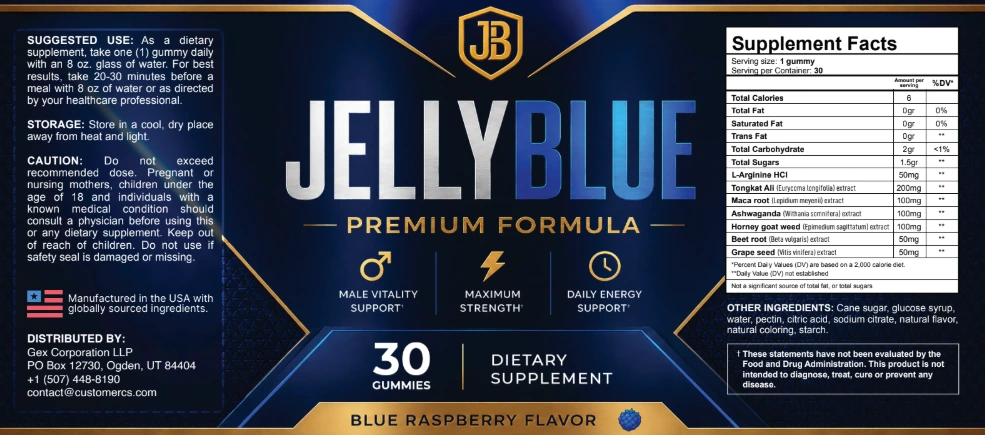
The printed Supplement Facts panel on this bottle names seven actives. Every piece of advertising shipped with it names six. The extra line is beet root extract at 50 mg, and of the seven it is the one whose mechanism, dietary nitrate to nitric oxide, has the largest randomised literature behind it.
Six on the advertising, seven on the bottle
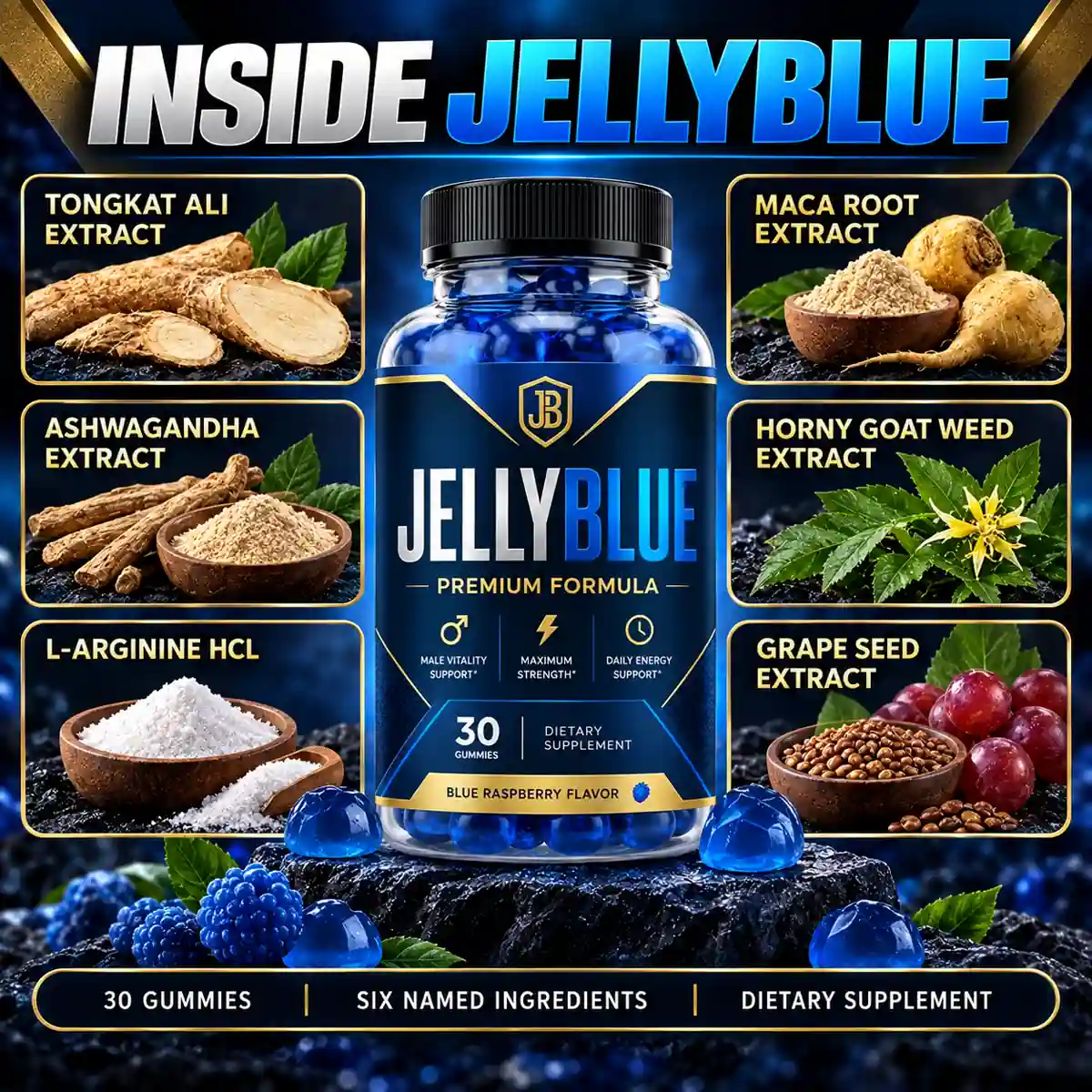
The vendor ships JellyBlue with a set of marketing graphics. One of them is called INSIDE JELLYBLUE and arranges six ingredient panels around a photograph of the bottle: tongkat ali, maca root, ashwagandha, horny goat weed, L-arginine HCl and grape seed. Its own footer reads “six named ingredients”. A second graphic counts “five named botanicals”, which is the same six minus the amino acid.
Turn the bottle round and the printed Supplement Facts panel lists seven. Between horny goat weed and grape seed sits a line the graphics do not carry: Beet root (Beta vulgaris) extract, 50 mg.
That is not a rounding difference or a naming convention. It is a whole ingredient present on the regulated statement and absent from every piece of advertising, and of the seven it is the one a sceptical reader would have expected to see named first.
- The printed panel names 7 actives. The advertising names 6.
- The extra line is beet root extract at 50 mg.
- Beetroot is the dietary source of nitrate, which the body turns into nitric oxide, which is what widens a blood vessel.
- Of the seven names in this formula, the nitrate route has the largest randomised literature behind it.
- The panel is the regulated statement on the container. Where the two disagree, the panel is the fact.
JellyBlue is a dietary supplement and not a treatment. Nothing here is medical advice. Erectile difficulty that is new or persistent is frequently the first sign of a cardiovascular problem, which makes it worth an appointment rather than a purchase, and MedlinePlus is a reasonable place to start reading.
Why the missing line is the interesting one
If an advertisement dropped grape seed, this article would be shorter. Beet root is different, because the mechanism behind it is the best-evidenced thing in the bottle.
Nitric oxide is a gas the body makes to tell the smooth muscle in a vessel wall to relax. When it relaxes, the vessel widens and blood moves through it more easily and at lower pressure. That is the pathway the prescription drugs in this category work on, from a different angle, and it is the pathway almost every serious ingredient in male-vitality formulas is aiming at.
There are two routes to it. The classical one runs through the amino acid arginine, which the body converts into nitric oxide directly. The second runs through dietary nitrate: nitrate from food is reduced to nitrite by bacteria living on the tongue, and the body carries that on to nitric oxide without using arginine at all. Beetroot is the food most associated with the second route.
And the second route has the better record. A systematic review and meta-analysis of medium-term dietary nitrate supplementation found a measurable fall in systolic blood pressure in adults, and the NIH fact sheet on supplements for exercise and athletic performance treats nitrate as one of the few ingredients in its whole remit with real support behind it. That document is conservative by design and dismisses most of what it covers.
| The two nitric oxide routes | What it needs | What the published record says |
|---|---|---|
| Arginine, the direct route | L-arginine, converted by the body | a dose-response meta-analysis found the blood-pressure effect concentrated above 4 g a day |
| Nitrate, the food route | Dietary nitrate plus bacteria on the tongue | a meta-analysis found a fall in systolic pressure at roughly 300 to 500 mg of nitrate a day |
| The vessel lining | Polyphenols acting on the endothelium | a meta-analysis of grape seed extract measured flow-mediated dilation directly, at 100 to 800 mg a day |
All three routes are present on this panel. The middle one is the one the advertising leaves out.
The part that is not flattering
50 mg of beet root extract is a long way from 300 to 500 mg of nitrate. Those are not even the same unit: the panel states an amount of extract, not an amount of nitrate, and it does not say what the extract is standardised to. Nothing on this container answers the question “how much nitrate is in one gummy”, so nothing on this website answers it either.
So the honest position has two halves that both have to be said. The route is real and well studied. The amount here is small and its nitrate content is not stated. Anybody buying this gummy for the beetroot alone would do better buying beetroot.
What makes the omission worth writing about is not the 50 mg. It is that a manufacturer with 7 ingredients on its panel chose 6 for its graphics and left out the one with the strongest mechanism. A reader is entitled to wonder why, and the only answer this desk can offer is that “beet root” reads as a vegetable rather than as a performance ingredient. That is a marketing judgement, and on the evidence it was the wrong one.
Order JellyBlue and read all seven lines
One chewable gummy a day, 30 to a bottle, 7 actives with a milligram figure beside every one. Two bottles covers the 60-day window exactly.
Price at the seller’s checkout · 60-day money-back guarantee from purchase
Order JellyBlue From This DeskLot JEL-26/JE-3218 · one gummy a day, 30 to a bottle · ships from the United States
What else beet root does on this panel
It is not the only line aimed at the nitric-oxide pathway, and that is the formula’s most interesting design idea.
L-arginine HCl at 50 mg is the direct substrate. Beet root at 50 mg is the nitrate route. Grape seed at 50 mg acts on the vessel lining itself. Three small pushes on one signal, from three directions that do not overlap biochemically.
Nobody has tested whether that adds up. There is no trial of the three together, at these amounts, in anybody, and this desk is not going to imply one by putting three citations in a row. What can be said is that the design makes sense on paper and that the amounts are small enough for the question to remain open.
For comparison, the ingredients page sets all seven lines against the amounts their own trials used, and six of the seven fall short.
The general rule a reader can take away
When a product’s advertising and its Supplement Facts panel disagree, believe the panel. Every time.
The panel is the regulated statement on the container a buyer receives. The advertising is a summary written to sell it, and a summary can drop a line for any reason at all: space, design, or a judgement that one name sells less well than another. The NIH consumer sheet on dietary supplements is worth reading on what a label is and is not required to say.
That rule is cheap to apply and it catches more than missing ingredients. It catches a serving size of three capsules advertised as a sixty-day bottle. It catches a proprietary blend presented as a list of amounts. And on this product it catches an extra ingredient, which is the rarer and more pleasant direction for the error to run in.
Three other places this pack rounds a fact off
Once you start comparing the advertising with the container, beet root turns out not to be the only place the two accounts differ. The other three are smaller, none of them is a misstatement, and they are the same habit.
Five named botanicals. One graphic counts five, another counts six, and both are internally consistent: the six include L-arginine HCl, an amino acid salt rather than a plant, so a count of botanicals correctly excludes it. A reader moving between the two graphics has no way to know that and ends up with two numbers and no explanation for either. The panel settles it with seven lines in one column.
Maximum strength. The second of the three phrases under the icons on the front of the bottle. It has no regulated definition, there is no strength scale for dietary supplements, and there is no maximum to be at. It is the manufacturer’s description of its own product. The honest translation is that the panel underneath it prints every amount, which is a genuinely unusual thing on this shelf and a smaller claim than the phrase sounds.
The asterisk convention. Each of the three front-label phrases carries a symbol pointing at the FDA sentence on the back: the statements have not been evaluated by the Food and Drug Administration and the product is not intended to diagnose, treat, cure or prevent any disease. That is the required counterweight to a structure and function claim, and the FDA sets out what that category of claim may say. A symbol does the job legally. It does not do it for somebody skimming the front of a bottle, which is why this website prints the sentence itself on every page instead of carrying the mark.
None of those three is dishonest. Taken together with the missing seventh ingredient they describe a pack whose regulated half is careful and whose marketing half is loose, which is the ordinary state of affairs in this category and the reason the rule above is worth learning.
Prints seven, everywhere. The panel page transcribes the whole box, the ingredients page gives beet root a card of its own,. Most pages selling this product print the marketing list of 6.
- Ashor AW, Lara J, Siervo M: Medium-term effects of dietary nitrate supplementation on systolic and diastolic blood pressure in adults: a systematic review and meta-analysis, J Hypertens 2017;35(7):1353-1359. PMID 28319596. https://pubmed.ncbi.nlm.nih.gov/28319596/
- Shiraseb F, Asbaghi O, Bagheri R, Wong A, Figueroa A, Mirzaei K: Effect of l-Arginine Supplementation on Blood Pressure in Adults: A Systematic Review and Dose-Response Meta-analysis of Randomized Clinical Trials, Adv Nutr 2022;13(4):1226-1242. PMID 34967840. https://pubmed.ncbi.nlm.nih.gov/34967840/
- Foshati S, Nouripour F, Sadeghi E, Amani R: The effect of grape (Vitis vinifera) seed extract supplementation on flow-mediated dilation, blood pressure, and heart rate: A systematic review and meta-analysis of controlled trials with duration- and dose-response analysis, Pharmacol Res 2022;175:105905. PMID 34798267. https://pubmed.ncbi.nlm.nih.gov/34798267/
- NIH Office of Dietary Supplements. Dietary Supplements for Exercise and Athletic Performance: Fact Sheet for Health Professionals. Accessed September 2026. https://ods.od.nih.gov/factsheets/ExerciseAndAthleticPerformance-HealthProfessional/
- NIH Office of Dietary Supplements. Dietary Supplements: What You Need to Know. Accessed September 2026. https://ods.od.nih.gov/factsheets/WYNTK-Consumer/
- US Food and Drug Administration. Structure/Function Claims. Accessed September 2026. https://www.fda.gov/food/nutrition-food-labeling-and-critical-foods/structurefunction-claims
- MedlinePlus. Dietary Supplements. US National Library of Medicine, accessed September 2026. https://medlineplus.gov/dietarysupplements.html