JellyBlue Official Website › Articles › Ingredients
IngredientsHorny Goat Weed At 100 mg: The Epimedium Species Question
"Horny goat weed" is a common name shared by dozens of Epimedium species, and the JellyBlue panel narrows that down to one: Epimedium sagittatum, at 100 mg. That is more specific than most competitor labels. It still leaves a real question open, because published analytical work shows the marker compound this genus is grown for can vary severalfold by species, by growing region, and by how the herb was processed, all before the evidence-gap question this site has already asked about icariin comes into it.
One common name, dozens of species
Epimedium is a genus of several dozen flowering plant species native mostly to East Asia, and a handful of them, including Epimedium sagittatum, Epimedium brevicornum, Epimedium koreanum and Epimedium pubescens among others, are harvested and sold interchangeably under the common English name "horny goat weed" or the Chinese name yin yang huo. The plant has a long history in traditional Chinese preparations, and several regional pharmacopeias recognize more than one species under the same entry, which is part of why the supplement trade inherited the same loose grouping. Commercial supplement listings routinely give only the common name or the bare genus, "Epimedium extract," without stating which species is inside, because the species distinction matters botanically and analytically far more than it matters to most shoppers reading a bottle quickly.
All of these species share a family of flavonoid compounds broadly called icariins, but they do not share them in equal amounts, and that is the gap this article is about. It is a different question from the one a companion article on this site already asks: that piece looks at whether icariin's laboratory evidence has been tested in real human trials at all. This one starts a step earlier, at the plant itself, and asks whether "100 mg of horny goat weed" from two different bottles is even the same starting material before any human-trial question gets applied to it. A reader who only takes one idea from this article should take this one: the common name on the front of a bottle and the species name in small print after it are two different claims, and only one of them is precise enough to check against the scientific literature.
- The JellyBlue panel names Epimedium sagittatum specifically, which is more precise than the generic "Epimedium extract" many competing labels print.
- A study of Epimedium sagittatum found its marker flavonoid content varied by growing region even within that single named species.
- A separate study measured icariin content across five different Epimedium species and found it changed further depending on whether the herb was heat-processed.
- The panel gives no extract ratio and no icariin percentage, so the 100 mg figure alone does not say how much icariin actually reaches the gummy.
- This article is about species and processing, not about whether icariin's evidence has been tested in people; that question is answered elsewhere on this site.
What the JellyBlue label actually specifies
The printed Supplement Facts panel gives the line as "Horny goat weed (Epimedium sagittatum) extract 100 mg," pairing the common name with a Latin binomial in parentheses, the same format used for every other botanical on the panel. Naming the species this specifically is worth crediting: a meaningful share of horny goat weed products on the market print only the common name or the bare genus, leaving a reader with no way to know which of the several commercially traded species is actually inside.
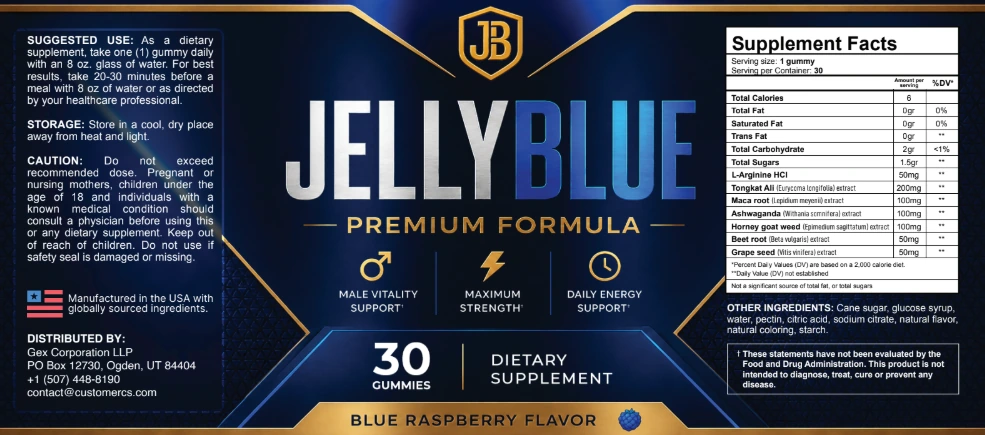
What the line does not carry is any further specification: no extract ratio such as 10:1, no stated percentage of icariin or total flavonoids, and the word "extract" with nothing describing how concentrated it is relative to the dried herb. That is the same gap the panel leaves for several of this formula's other botanicals, and it means the species name, useful as it is, answers only part of the question a buyer might actually want answered.
Why species and processing move the icariin number
Two pieces of published analytical work show how much that missing specification can matter. The first looked specifically at Epimedium sagittatum, the exact species JellyBlue names, and found that plants of that one species collected from a distinct geographical accession showed variation in their medicinal flavonoid components, meaning the same named species did not deliver a fixed, predictable marker-compound content just because the label said the right Latin name.
The second study went wider, tracking icariin content across five separate Epimedium species and measuring how that content changed after a heating process, a common step in traditional preparation. Icariin content moved substantially across the five species even before processing, and moved again, in some cases in the opposite direction from others, once heat was applied. Related work on flavonoid content in processed versus raw Epimedium material found the same pattern: heating time and method, not just species, is an independent variable that shifts the numbers.
| Variable | What the analytical work found | What that means for a 100 mg label line |
|---|---|---|
| Species | Icariin content differed across five Epimedium species measured side by side. | "Epimedium" alone, without a named species, tells a reader almost nothing about marker content; naming the species, as this panel does, is a real but partial improvement. |
| Growing origin, within one species | Epimedium sagittatum from a distinct geographical accession showed its own variation in medicinal components. | Even the correct species name does not guarantee a fixed content; where the plant was grown is a second variable the label cannot show. |
| Processing (heating) | Icariin content shifted, and shifted differently by species, after a heating step. | Whether and how the raw herb was processed before extraction is a third variable, and the panel is silent on it. |
Three variables, one milligram figure. The 100 mg on this panel is a weight of extract, not a measured dose of icariin, and none of the three variables above is visible from the bottle itself.
What a heating step traditionally accomplishes
The heating step measured in that second study is not an accident of modern manufacturing; it echoes a traditional preparation step called zhi, in which the raw dried herb is fried, often with a small amount of a liquid such as honey, before use. Traditional preparation methods like this were developed for reasons that predate modern analytical chemistry, generally to change how a raw herb behaves in the body or to moderate a quality practitioners considered too strong or too drying in its raw form. Whatever the traditional rationale, the analytical result is measurable and specific: heating shifted icariin content, and it shifted it by different amounts and even different directions across the five species that study compared, which means a "heat-processed" or "raw" note on a supplement label, where one is given at all, is itself a piece of information a buyer could use and almost never gets.
JellyBlue’s own panel does not say whether its horny goat weed extract was made from raw or heat-processed material, which puts it in the same position as the extract-ratio and icariin-percentage gaps already described: not unusual for the category, but a real limit on what the 100 mg figure can tell a careful reader on its own.
Order JellyBlue knowing what the species line does and does not prove
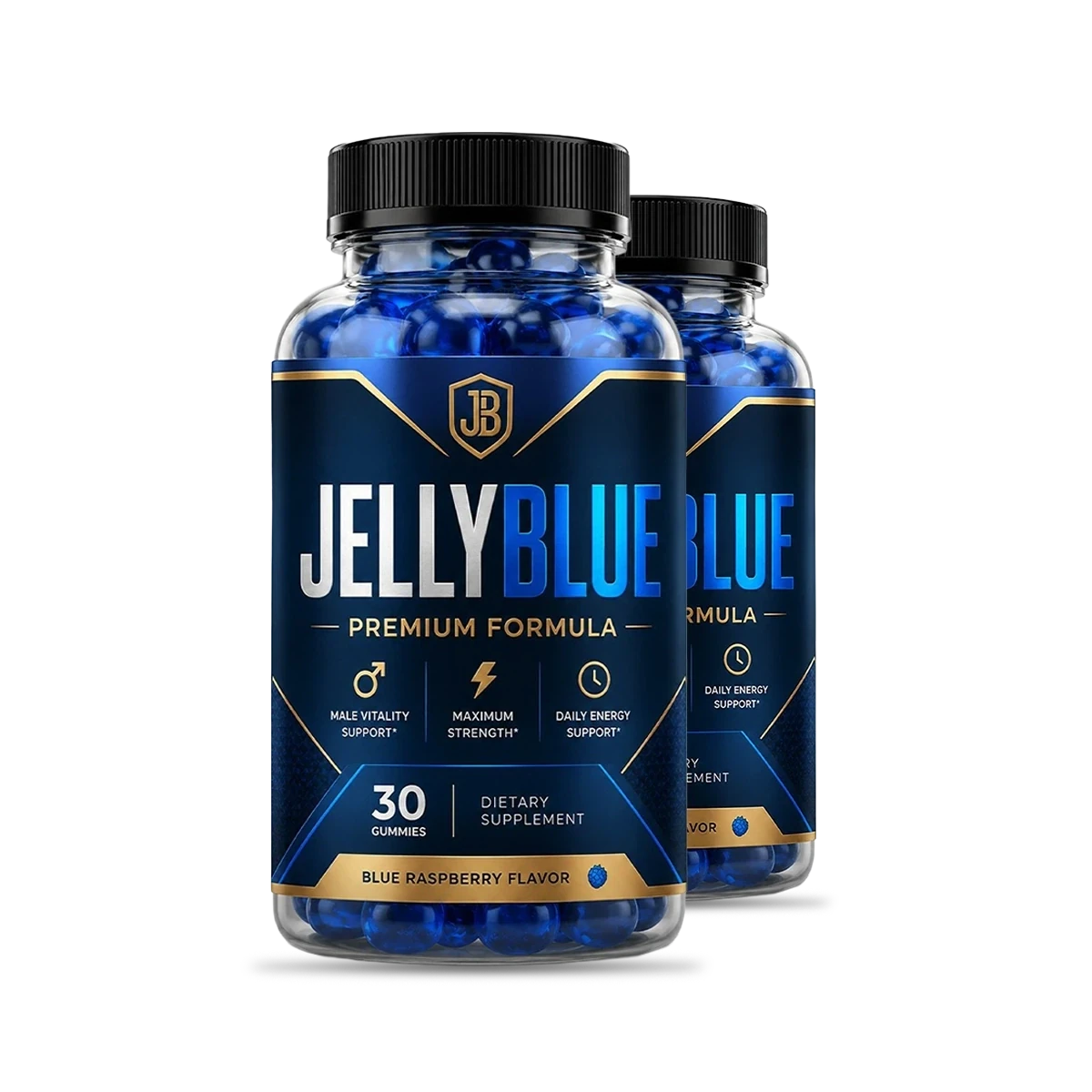
One chewable gummy a day, 30 to a bottle, 7 actives with a milligram figure beside every one. Two bottles covers the 60-day window exactly.
Price at the seller’s checkout · 60-day money-back guarantee from purchase
Order JellyBlueIcariin's own evidence, briefly
This site's dose-comparison article already covers the evidence-gap side of horny goat weed in detail: a laboratory assay found icariin derivatives potently inhibit the same PDE5 enzyme that prescription erectile-dysfunction medicines target, and a broader review of plant-derived compounds screened for PDE5-inhibiting activity places icariin among the more studied candidates in that laboratory literature. Neither of those is a human trial, and neither gives a milligram or icariin-percentage amount that a person could compare against 100 mg of extract, which is exactly the point that article makes.
What this article adds, rather than repeats, is that the laboratory evidence behind icariin was necessarily generated using a specific, characterized source of the compound, not "Epimedium" as a generic category. A researcher isolating icariin for a PDE5 assay knows exactly how much of it they are testing, because purifying or synthesizing a single compound for lab work removes the species and processing variation this article has been describing; the compound in the test tube is defined by its own chemical structure, not by which plant it happened to originate in. A shopper reading "Epimedium sagittatum extract 100 mg" on a gummy label does not have that same clarity, for the species-and-processing reasons set out above, which sits underneath and separate from the human-trial question already answered elsewhere on this site.
Put the two articles together and the picture is more complete than either gives alone. The dose-comparison piece establishes that even a well-characterized dose of pure icariin has not been tested against this outcome in a randomized human trial, only in laboratory and animal work. This piece establishes that the 100 mg of extract on the panel is not even a well-characterized dose of icariin to begin with, since the species-and-processing gap means the actual icariin content of that 100 mg is unknown from the label alone. Neither gap disproves the other; they simply sit on top of each other, and a reader who has only read one of the two articles has only half the picture.
What a shopper can and cannot check
Set against the wider horny goat weed market, this label does two things well: it prints a milligram figure at all, rather than folding the ingredient into an undisclosed proprietary blend, and it names the species rather than leaving the genus generic. Both are real, checkable commitments a reader can hold the company to.
What a reader cannot do from this panel alone is work out how much icariin, specifically, reaches the gummy. That would require an extract ratio, a stated icariin or total-flavonoid percentage, or a certificate of analysis for this batch, none of which is printed here. Absent that, the honest reading of the 100 mg line is that it names a real, specific, correctly identified plant species, at a stated weight of extract, without stating how much of the compound the laboratory evidence above is actually about.
For a reader who wants to push further than the label allows, three checks are worth trying in order. First, ask the seller directly, in writing, whether the extract carries a stated icariin or total-flavonoid percentage and, if so, what it is; a specific number in reply is worth far more than a repeated milligram figure. Second, ask whether the material is raw or heat-processed, since the analytical work above shows that single processing choice moves the marker content on its own. Third, ask whether a certificate of analysis is available for the batch in hand, which is the only document that would actually settle the question for that specific bottle rather than for the ingredient category in general. A seller able to answer even one of those three specifically is giving a more useful answer than the panel does by itself.
The dose-comparison article already covers icariin's laboratory-versus-human evidence gap for this same 100 mg line, and the ingredients page carries the full botanical list this label prints. This article covers the species and processing question that sits underneath both.
- Liang Q, Wei G, Chen J, Wang Y, Huang H. Variation of medicinal components in a unique geographical accession of horny goat weed Epimedium sagittatum Maxim. Molecules. 2012;17(11):13345-56. PMID 23138537. https://pubmed.ncbi.nlm.nih.gov/23138537/
- Sun XG, Zhou M, Ma BP, Guo BL. Change of icariin content in five Epimedium species by heating process. Zhongguo Zhong Yao Za Zhi. 2019;44(9):1857-1861. PMID 31342713. https://pubmed.ncbi.nlm.nih.gov/31342713/
- Arief ZM, Munshi AH, Shawl AS. Evaluation of medicinal value of Epimedium elatum on the basis of pharmacologically active constituents, Icariin and Icariside-II. Pak J Pharm Sci. 2015;28(5):1665-9. PMID 26408886. https://pubmed.ncbi.nlm.nih.gov/26408886/
- Dell’Agli M, Galli GV, Dal Cero E, Belluti F, Matera R, Zironi E, Pagliuca G, Bosisio E. Potent inhibition of human phosphodiesterase-5 by icariin derivatives. J Nat Prod. 2008;71(9):1513-7. PMID 18778098. https://pubmed.ncbi.nlm.nih.gov/18778098/
- Anand Ganapathy A, Hari Priya VM, Kumaran A. Medicinal plants as a potential source of Phosphodiesterase-5 inhibitors: A review. J Ethnopharmacol. 2021;267:113536. PMID 33137431. https://pubmed.ncbi.nlm.nih.gov/33137431/
- NIH Office of Dietary Supplements. Dietary Supplements: What You Need to Know. Accessed September 2026. https://ods.od.nih.gov/factsheets/WYNTK-Consumer/