JellyBlue Official Website › Articles › Dose analysis
Dose analysisJellyBlue Ingredients and Dosage Compared With Studies
The JellyBlue ingredients list is seven actives, every one printed with its own amount, 650 mg in all in one gummy taken once a day with an 8 oz glass of water. Set against the amounts the published trials used, one line matches exactly, tongkat ali at 200 mg, and six fall short, three of them by an order of magnitude. Here is the whole comparison in one table.
Seven amounts, seven records
One JellyBlue gummy carries 650 mg of actives across 7 names. Every one of those amounts is printed on the container, which is unusual enough in this category to be the strongest thing about the product. This article does the other half of the job: it sets each amount beside what the published trials actually used.
| Ingredient | In one gummy | What the trials cited here used | Source |
|---|---|---|---|
| Tongkat Ali | 200 mg | 200 to 400 mg a day of a standardised water extract | the record |
| Maca Root | 100 mg | 1,500 mg and 3,000 mg a day for twelve weeks | the record |
| Ashwagandha | 100 mg | 125 mg to 600 mg a day of a root extract | the record |
| Horny Goat Weed | 100 mg | a laboratory assay, not a dose taken by anybody | the record |
| L-Arginine HCl | 50 mg | 4 g to 24 g a day; the effect concentrated above 4 g | the record |
| Beet Root | 50 mg | about 300 to 500 mg of nitrate a day, from juice or salt | the record |
| Grape Seed | 50 mg | 100 mg to 800 mg a day for four to sixteen weeks | the record |
Trial amounts are read from the abstracts of the records in the last column, in the session those records were verified through the NCBI service.
JellyBlue is a dietary supplement and not a treatment. Nothing here is medical advice. Erectile difficulty that is new or persistent is frequently the first sign of a cardiovascular problem, which makes it worth an appointment rather than a purchase, and MedlinePlus is a reasonable place to start reading.
The one line that matches
Tongkat ali, at 200 mg.
That is not a coincidence and it is worth crediting. The six-month, double-blind, placebo-controlled randomised trial in older men with androgen deficiency used 200 mg a day of a standardised extract. The panel prints 200 mg. On this one line, the label and the literature are describing the same number.
Two caveats belong immediately beside that, because the credit is real and it is narrow. Extracts are standardised differently and the panel does not say what this one is standardised to, so 200 mg here and 200 mg there are the same weight of possibly different material. And a trial of one ingredient for six months is not a trial of that ingredient alongside six others in a gummy. The meta-analysis of tongkat ali and total testosterone pools small trials of the extract, not of this product.
Still: one line out of seven where a supplement label matches a trial amount exactly is better than most of this shelf manages.
The six that fall short, in order of how far
L-arginine: 50 mg against four grams
The bluntest gap on the panel. The dose-response meta-analysis of oral arginine and blood pressure pooled trials from 4 g to 24 g a day and found the effect concentrated at the upper end. 50 mg is eighty times below the bottom of that range. Read honestly, this is a nod to a pathway rather than a dose of it.
Maca: 100 mg against one and a half to three grams
The trials behind maca’s reputation used grams. The landmark 2002 randomised trial gave 1,500 mg and 3,000 mg a day for twelve weeks, and the later trial in men with mild erectile dysfunction used 2,400 mg. At 100 mg this is between a fifteenth and a thirtieth of what was tested.
Ashwagandha: 100 mg against three to six hundred
Most arms in the stress and anxiety meta-analysis and the sleep meta-analysis used 300 to 600 mg a day of a root extract. 100 mg is a sixth of the upper figure. The ashwagandha here is also, incidentally, the ingredient with a published liver-injury case series behind it, and a smaller amount is a smaller exposure, which is the one place on this panel where falling short is not a disadvantage.
Beet root and grape seed: 50 mg each, against units that do not match
Beet root is stated as 50 mg of extract; the nitrate literature works in milligrams of nitrate, and the panel does not say how much nitrate the extract carries, so the two figures cannot be compared at all. Grape seed at 50 mg sits below the 100 to 800 mg range in the flow-mediated dilation meta-analysis.
Horny goat weed: 100 mg against nothing
There is no human trial amount to compare against. The icariin work is a laboratory assay of purified derivatives against PDE5, and the review of plant-derived PDE5 inhibitors is clear about the distance between that and a person taking a plant extract. The column is empty because the record is.
Order JellyBlue with the comparison in front of you
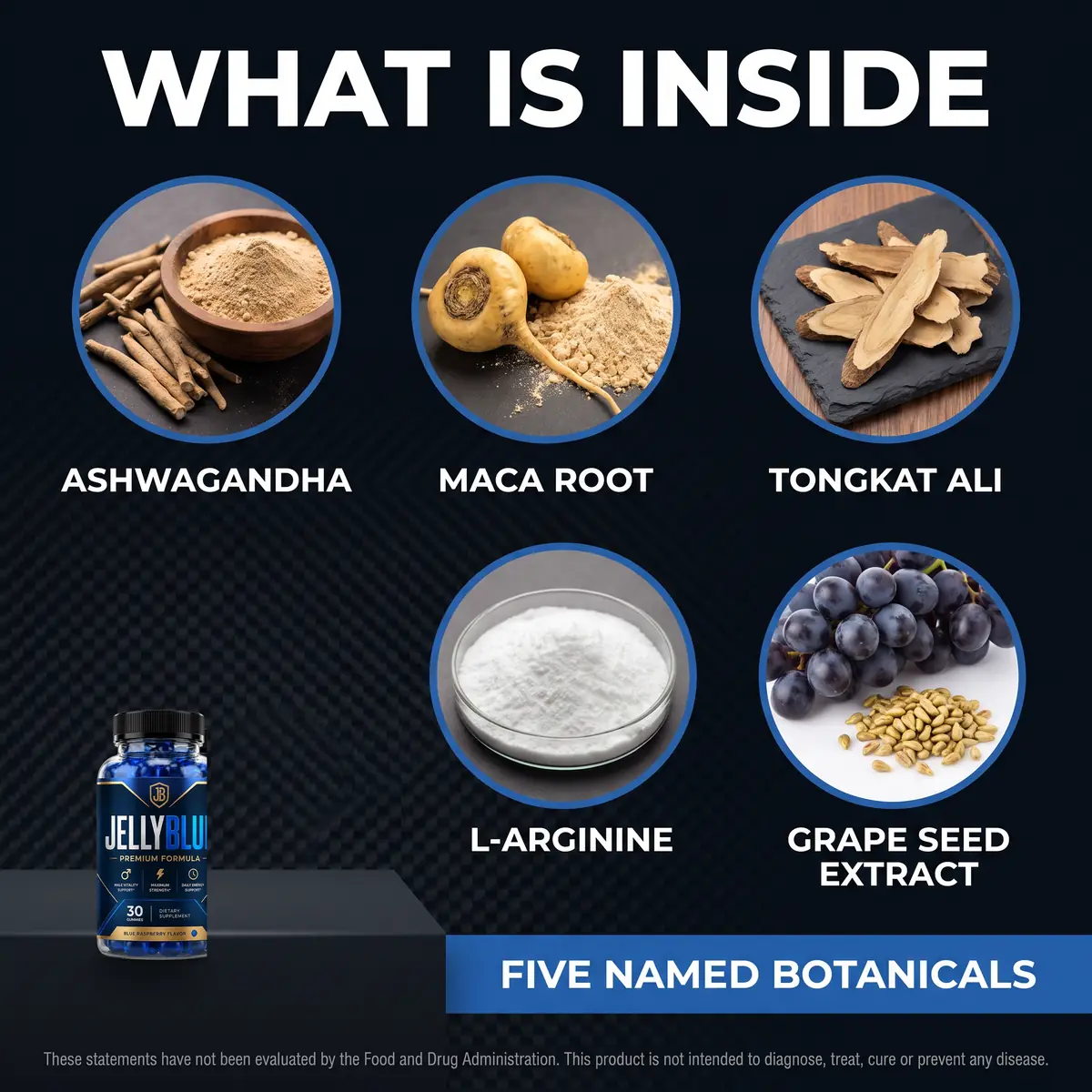
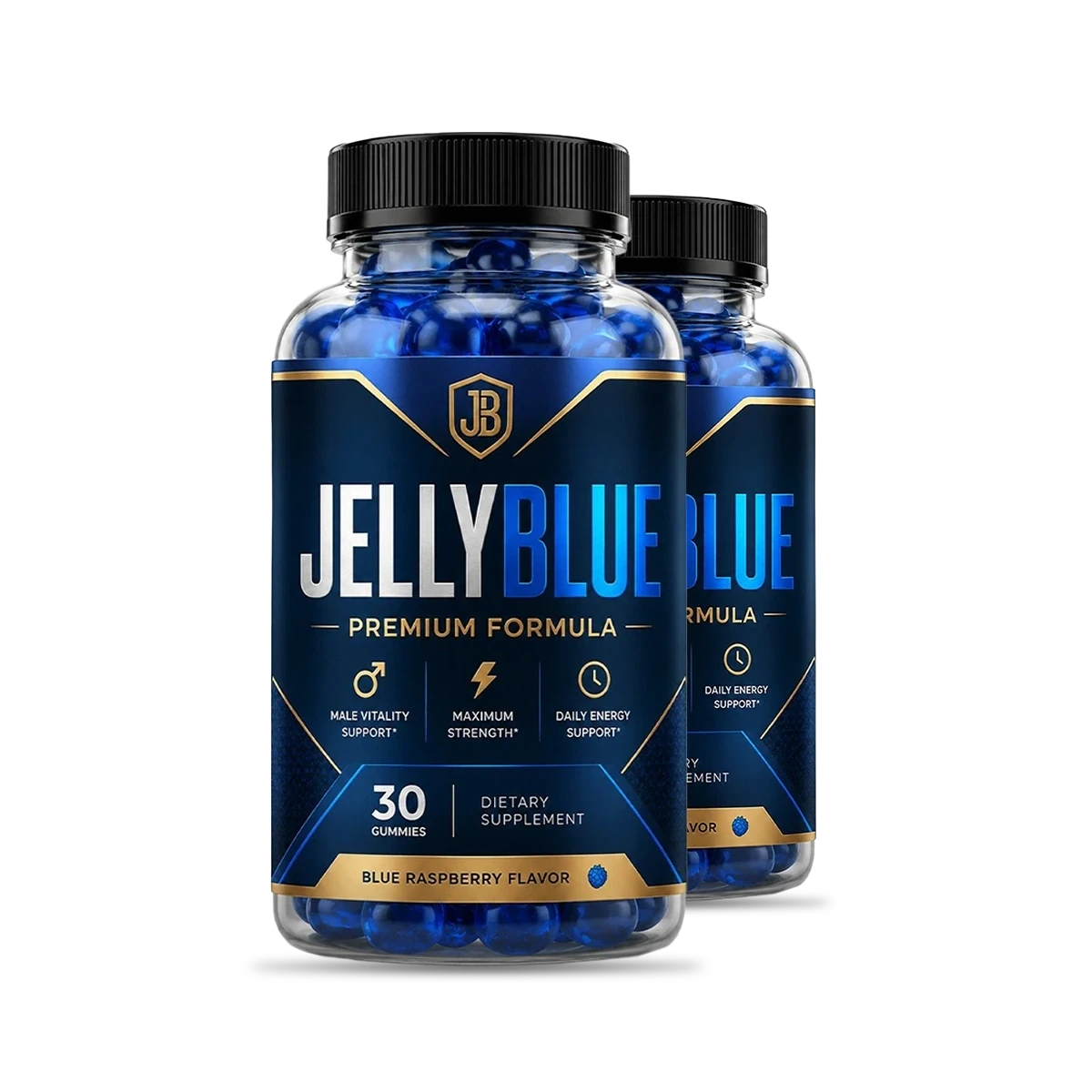
One chewable gummy a day, 30 to a bottle, 7 actives with a milligram figure beside every one. Two bottles covers the 60-day window exactly.
Price at the seller’s checkout · 60-day money-back guarantee from purchase
Order JellyBlue From This DeskLot JEL-26/JE-3218 · one gummy a day, 30 to a bottle · ships from the United States
The two fair counterweights
A table like the one above is easy to read as a verdict, and it should not be. Two things push back on it.
These seven are not meant to work alone. Three of them, arginine, beet root and grape seed, converge on one pathway from three biochemically separate directions. Nobody has tested whether three small pushes on one signal add up to more than three small pushes, and the honest description of that is an open question rather than a debunking.
A gummy is a volume problem. Most of a gummy is pectin and sweetener. 650 mg of actives is a reasonable figure for the format and a modest one for a capsule, and a reader comparing the two on milligrams is comparing different physical constraints. That is the format’s cost, and its benefit is adherence: a gummy people actually finish beats a capsule abandoned on day nine.
Neither counterweight makes 50 mg of arginine into 4 g. They make the comparison a reason to set expectations rather than a reason to dismiss the product.
What to do with this
- Expect nothing in week one. There is no stimulant here, so there is nothing to feel early.
- Judge it on how a month feels rather than on a number. No panel at these amounts is going to announce itself.
- Buy the smallest pack that covers the refund window, which is the two or the three-bottle. The pricing page says which and why.
- If one ingredient in the table is the reason you are buying, buy that ingredient on its own instead. At trial amounts, and for less money.
What a fair label in this category would look like
A table of shortfalls invites an obvious question: what would a label have to print for the comparison to come out well? It is worth answering, because the answer is not “bigger numbers” and it tells a reader what to look for on the next product they pick up.
- An amount beside every active, with no blend total. This product already does it, and it is the precondition for everything else. Without it there is no comparison to make.
- The standardisation, not just the weight. “Tongkat ali 200 mg” and “tongkat ali 200 mg, standardised to 2% eurycomanone” are different statements, and only the second can be lined up against a trial that used a standardised extract. Almost no label in this category prints the second.
- A nitrate figure for a nitrate ingredient. Beet root extract is stated here in milligrams of extract. The literature works in milligrams of nitrate. Until a label bridges those two units the comparison cannot be made at all, which is why the beet root row above is the one with no honest entry in it.
- Fewer names, larger amounts. The arithmetic of a fixed volume is unavoidable: seven ingredients in a gummy means seven small numbers. Three ingredients at trial amounts would be a more defensible formula and a less impressive-looking one, and the shelf rewards the second.
- A sentence about what was not studied. No label will ever print this, which is why a website selling the product has to.
Judged against that list, this panel passes the first test, fails the second and third, and makes the fourth trade-off in the usual direction. That is a better score than most of its shelf and it is not a good score in absolute terms, and both halves of that sentence are true at once.
It also explains why the two guides on this website are worth more to a buyer than any product page. The nine-point checklist puts itemised amounts first and dose comparison second, in that order, for exactly the reason this section sets out: the first is a property of the label, and the second is only answerable once the first is true.
Every figure above is true, and repeating it in every section of every page would turn an accurate website into an argument against buying anything. It is printed here, in one table, and on the ingredients page, and nowhere else as an aside. That is a deliberate editorial choice and it is the one this desk would defend.
- Leitão AE, Vieira MCS, Pelegrini A, da Silva EL, Guimarães ACA: A 6-month, double-blind, placebo-controlled, randomized trial to evaluate the effect of Eurycoma longifolia (Tongkat Ali) and concurrent training on erectile function and testosterone levels in androgen deficiency of aging males (ADAM), Maturitas 2021;145:78-85. PMID 33541567. https://pubmed.ncbi.nlm.nih.gov/33541567/
- Leisegang K, Finelli R, Sikka SC, Panner Selvam MK: Eurycoma longifolia (Jack) Improves Serum Total Testosterone in Men: A Systematic Review and Meta-Analysis of Clinical Trials, Medicina (Kaunas) 2022;58(8). PMID 36013514. https://pubmed.ncbi.nlm.nih.gov/36013514/
- Shiraseb F, Asbaghi O, Bagheri R, Wong A, Figueroa A, Mirzaei K: Effect of l-Arginine Supplementation on Blood Pressure in Adults: A Systematic Review and Dose-Response Meta-analysis of Randomized Clinical Trials, Adv Nutr 2022;13(4):1226-1242. PMID 34967840. https://pubmed.ncbi.nlm.nih.gov/34967840/
- Gonzales GF, Córdova A, Vega K, Chung A, Villena A, Góñez C, Castillo S: Effect of Lepidium meyenii (MACA) on sexual desire and its absent relationship with serum testosterone levels in adult healthy men, Andrologia 2002;34(6):367-72. PMID 12472620. https://pubmed.ncbi.nlm.nih.gov/12472620/
- Zenico T, Cicero AF, Valmorri L, Mercuriali M, Bercovich E: Subjective effects of Lepidium meyenii (Maca) extract on well-being and sexual performances in patients with mild erectile dysfunction: a randomised, double-blind clinical trial, Andrologia 2009;41(2):95-9. PMID 19260845. https://pubmed.ncbi.nlm.nih.gov/19260845/
- Arumugam V, Vijayakumar V, Balakrishnan A, Bhandari RB, Boopalan D, Ponnurangam R, Sankaralingam Thirupathy V, Kuppusamy M: Effects of Ashwagandha (Withania Somnifera) on stress and anxiety: A systematic review and meta-analysis, Explore (NY) 2024;20(6):103062. PMID 39348746. https://pubmed.ncbi.nlm.nih.gov/39348746/
- Cheah KL, Norhayati MN, Husniati Yaacob L, Abdul Rahman R: Effect of Ashwagandha (Withania somnifera) extract on sleep: A systematic review and meta-analysis, PLoS One 2021;16(9):e0257843. PMID 34559859. https://pubmed.ncbi.nlm.nih.gov/34559859/
- Björnsson HK, Björnsson ES, Avula B, Khan IA, Jonasson JG, Ghabril M, Hayashi PH, Navarro V: Ashwagandha-induced liver injury: A case series from Iceland and the US Drug-Induced Liver Injury Network, Liver Int 2020;40(4):825-829. PMID 31991029. https://pubmed.ncbi.nlm.nih.gov/31991029/
- Ashor AW, Lara J, Siervo M: Medium-term effects of dietary nitrate supplementation on systolic and diastolic blood pressure in adults: a systematic review and meta-analysis, J Hypertens 2017;35(7):1353-1359. PMID 28319596. https://pubmed.ncbi.nlm.nih.gov/28319596/
- Foshati S, Nouripour F, Sadeghi E, Amani R: The effect of grape (Vitis vinifera) seed extract supplementation on flow-mediated dilation, blood pressure, and heart rate: A systematic review and meta-analysis of controlled trials with duration- and dose-response analysis, Pharmacol Res 2022;175:105905. PMID 34798267. https://pubmed.ncbi.nlm.nih.gov/34798267/
- Dell'Agli M, Galli GV, Dal Cero E, Belluti F, Matera R, Zironi E, Pagliuca G, Bosisio E: Potent inhibition of human phosphodiesterase-5 by icariin derivatives, J Nat Prod 2008;71(9):1513-7. PMID 18778098. https://pubmed.ncbi.nlm.nih.gov/18778098/
- Anand Ganapathy A, Hari Priya VM, Kumaran A: Medicinal plants as a potential source of Phosphodiesterase-5 inhibitors: A review, J Ethnopharmacol 2021;267:113536. PMID 33137431. https://pubmed.ncbi.nlm.nih.gov/33137431/