JellyBlue Official Website › Articles › Side effects
Safety and useJelly Blue Side Effects: What to Know Before You Start
Most people who read about Jelly Blue side effects want three answers: what is likely, what is rare, and who should check with a doctor before the first gummy. This page reads the printed label line by line and sets out each answer in plain words.
Quick answer. The likely Jelly Blue side effects are mild and digestive, and the panel has no stimulant. Three of the seven actives act on blood-vessel width, so anyone who takes a nitrate, a blood-pressure medicine or a PDE5 inhibitor should ask a doctor first. Ashwagandha has a rare liver note in its published research, so people with liver disease should skip this bottle.
What side effects can Jelly Blue cause?
The likely Jelly Blue side effects are mild and digestive. The usual cause is the format rather than any one ingredient: a chewable gummy eaten on an empty stomach, 20 to 30 minutes before a meal as the label suggests, can leave some people with a slightly unsettled stomach.
The simple fix is to take the gummy with food instead. That moves away from the label’s preferred timing, but it is the first thing to try if your stomach complains, and it keeps the dose at the one gummy a day the label directs.
Beet root can colour urine or stool pink or red. The site notes that this is harmless and unlikely at the 50 mg of extract in each gummy, but it helps to know about it in advance.
Is there a stimulant in Jelly Blue?
No. The Supplement Facts panel prints seven actives, each with its own milligram amount, and none of them is a stimulant. That is why the first week is usually quiet, and it is also why jitters or a racing heart are not what this formula is built around.
If you notice something unusual after a gummy, treat it as information. Stop, note what you ate and when, and talk to your doctor. A label can describe what is in the bottle, but only a clinician can look at your own health.
Which medicines call for a doctor’s advice first?
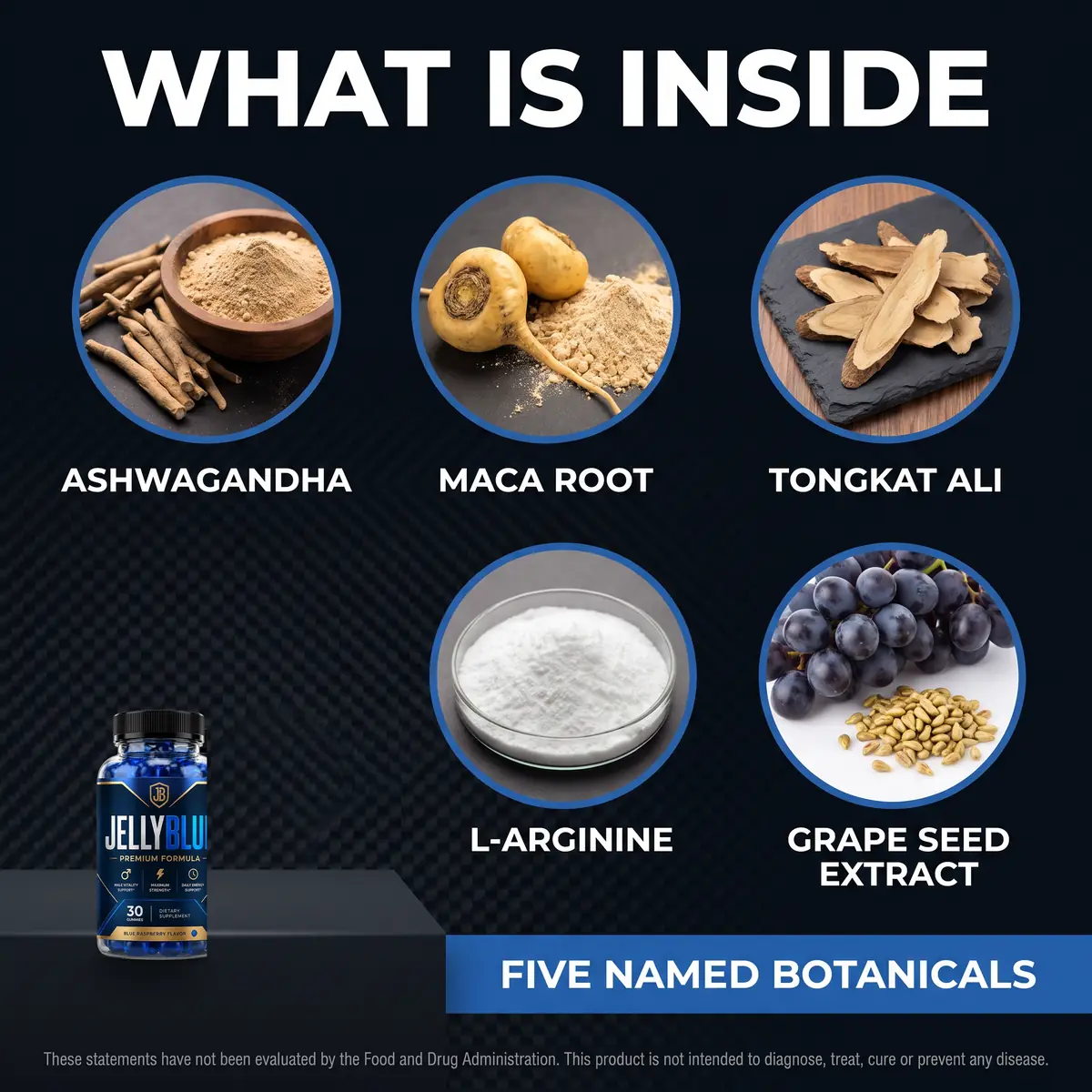
Three classes of medicine act on the same pathway as three of the seven lines. L-arginine is the substrate the body builds nitric oxide from, beet root carries dietary nitrate, and grape seed acts on the vessel lining. Nitrates, blood-pressure medicines and PDE5 inhibitors work on that same route, so the effects can add up and lower blood pressure further.
At the amounts on the panel the addition is likely to be small. Even so, it is a short question for a prescriber, and the best moment to ask is before the first gummy rather than after the third week.
Order Jelly Blue through the official path
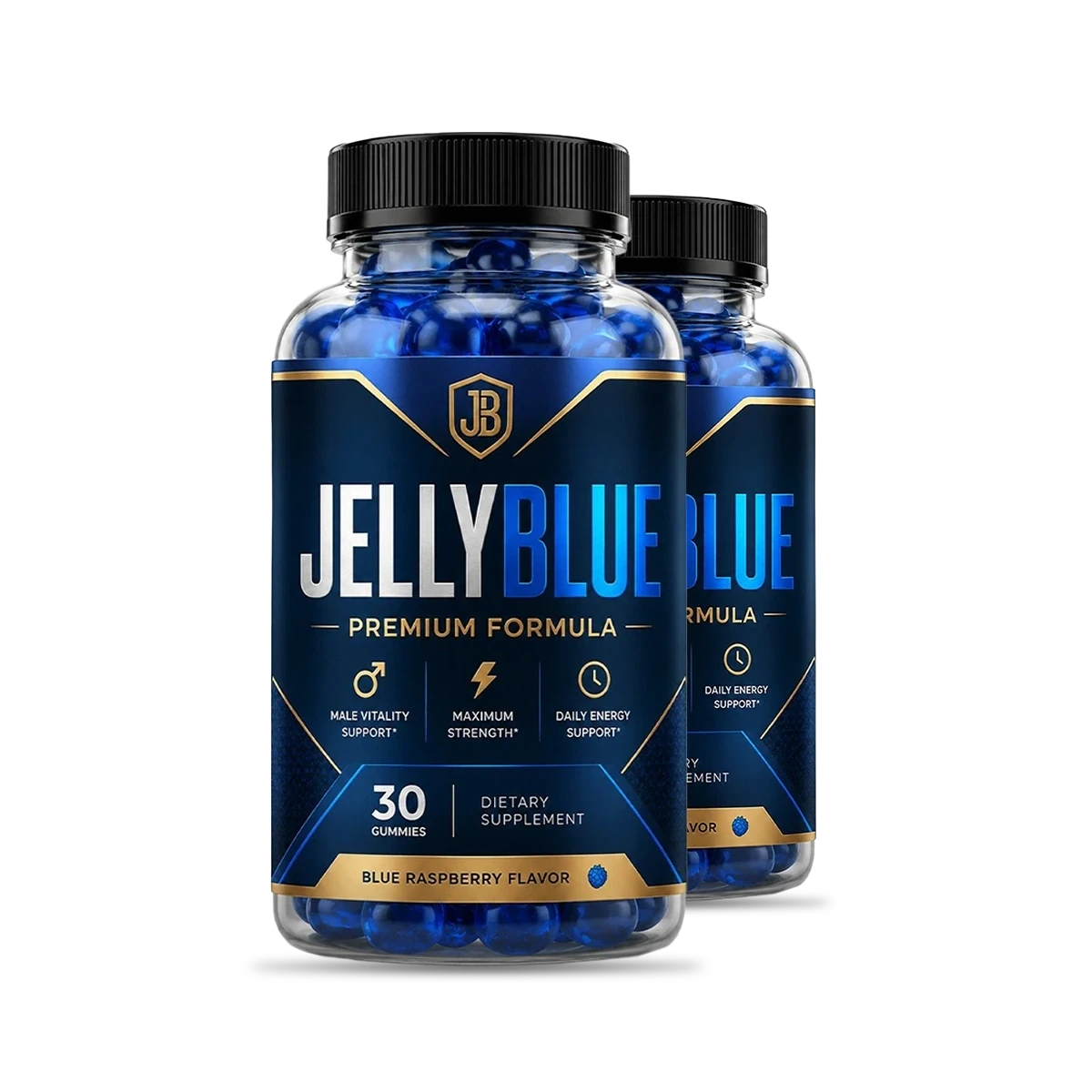
Thirty gummies a bottle, one a day, and a 60-day money-back guarantee counted from purchase.
Price at the seller’s checkout · 60-day money-back guarantee from purchase
See the price and 60-day guaranteeLot JEL-26/JE-3218 · one gummy a day, 30 to a bottle · Jellyeblue earns when you buy through the order link
What is the liver note on ashwagandha?
Each gummy holds 100 mg of ashwagandha root extract. A published case series from Iceland and the US Drug-Induced Liver Injury Network linked ashwagandha products to liver injury, and NCCIH carries the same note. The cases are rare against very wide use and involved products with far more ashwagandha than 100 mg.
The practical advice is narrow. Anyone with liver disease should leave this bottle alone. Everyone else should know that unexplained tiredness, dark urine or yellow eyes are reasons to stop any supplement and see a doctor.
Who should ask a doctor before taking Jelly Blue?
The container asks pregnant or nursing mothers, children under 18 and anyone with a known medical condition to consult a physician before using this or any dietary supplement. Jelly Blue is written for healthy men aged 18 and over.
The label also says not to exceed the recommended dose, to keep the bottle out of reach of children and not to use it if the safety seal is damaged or missing. One gummy a day is the serving.
How much sugar is in a Jelly Blue gummy?
One gummy carries 6 calories, 2 g of carbohydrate and 1.5 g of total sugars. That is small in a normal day, and the figure is printed so that anyone counting carbohydrate can count it. The other ingredients are listed in the label’s order, starting with cane sugar and glucose syrup, and include pectin.
Jelly Blue side effects at a glance
- Likely effects: mild and digestive, often settled by taking the gummy with food.
- No stimulant on the panel.
- Ask a doctor first if you take a nitrate, a blood-pressure medicine or a PDE5 inhibitor.
- Liver disease: skip this bottle because of the ashwagandha row.
- Not for anyone under 18, and pregnant or nursing mothers should ask a physician first.
- Sugar: 1.5 g a gummy, with 6 calories.
- Dose: one gummy a day, never more.
What does the label say about safety?
| Topic | What is printed or published |
|---|---|
| Daily dose | One gummy a day |
| Maximum | Do not exceed recommended dose |
| Age | Healthy adults 18 and over |
| Pregnant or nursing | Consult a physician first |
| Known medical condition | Consult a physician first |
| Stimulant | None listed on the panel |
| Seal | Do not use if the safety seal is damaged or missing |
| Storage | Cool, dry place away from heat and light |
Taken from the container caution paragraph and the JellyBlue side effects page.
Frequently asked questions
What are the side effects of Jelly Blue?
The likely ones are mild and digestive, most often from chewing a gummy on an empty stomach. Taking it with food usually settles that. The panel lists no stimulant.
Does Jelly Blue cause jitters or a racing heart?
The panel shows no stimulants, so jitters are not what the formula is built around. Anything unusual is a reason to stop and talk to a doctor.
Can I take Jelly Blue with blood-pressure medicine?
Ask your doctor first. L-arginine, beet root and grape seed act on blood-vessel width, and so do nitrates, blood-pressure medicines and PDE5 inhibitors, so the effects can add up.
Who should not take Jelly Blue?
The label asks pregnant or nursing mothers, anyone under 18 and anyone with a known medical condition to consult a physician first. People with liver disease should skip it because of the ashwagandha row.
Our view
Jelly Blue side effects, in short: mild digestive upset is the most likely, a stimulant is not part of the formula, and three groups of medicine are worth a conversation with a prescriber. That is a manageable list, and every item on it can be checked against the label.
If you are a healthy adult, take one gummy a day as directed and watch how you feel. If you take regular medicine, ask first. You can read the full panel on the Supplement Facts page.
Related reading: the JellyBlue side effects page, who JellyBlue is for, the article on daily use and label limits and the JellyBlue home page.
Order JellyBlue through the official path
Thirty gummies a bottle, a 60-day guarantee from purchase, and an order line that can see your order.
Price at the seller’s checkout · 60-day money-back guarantee from purchase
See the price and 60-day guaranteeLot JEL-26/JE-3218 · one gummy a day, 30 to a bottle · ships from the United States · Jellyeblue earns when you buy through the order link
- Björnsson HK, Björnsson ES, Avula B, Khan IA, Jonasson JG, Ghabril M, Hayashi PH, Navarro V: Ashwagandha-induced liver injury: A case series from Iceland and the US Drug-Induced Liver Injury Network, Liver Int 2020;40(4):825-829. PMID 31991029. https://pubmed.ncbi.nlm.nih.gov/31991029/
- National Center for Complementary and Integrative Health. Using Dietary Supplements Wisely. NIH. https://www.nccih.nih.gov/health/using-dietary-supplements-wisely
- MedlinePlus. Dietary Supplements. US National Library of Medicine. https://medlineplus.gov/dietarysupplements.html