JellyBlue Official Website › Articles › Ingredients
IngredientsTongkat Ali At 200 mg: What Standardized Extract Should Mean
Tongkat Ali is the largest single line on the JellyBlue panel at 200 mg, and it is easy to read that number as the whole story. It is not. Almost every published trial behind this ingredient used a specific, named, standardized extract, and the panel does not say whether this one is that, something similar, or plain root powder. This article is about the line the label leaves blank.
The number that is not the whole story
A separate article on this site sets every one of JellyBlue’s seven amounts against the amount its own cited trials used, and Tongkat Ali’s 200 mg came out closer to trial range than almost anything else on the panel. That comparison, useful as it is, quietly assumes something the panel never states: that 200 mg of "Tongkat Ali (Eurycoma longifolia)" on this label is the same kind of 200 mg the trials gave their subjects.
It might be. It might not be. Root bark, root powder, a water extract, and a specific patented standardized extract can all be truthfully labelled "Tongkat Ali" at 200 mg, and they are not interchangeable. This article sets aside the dose-versus-trial question already answered elsewhere and asks a narrower one: what does the word "extract" actually promise, and does this label deliver on it.
- The panel says "Tongkat Ali (Eurycoma longifolia) 200 mg" and nothing about the extract form, ratio, or marker-compound content behind that figure.
- Published human trials that measured testosterone, mood or quality-of-life outcomes almost all used a specific, named, standardized extract rather than raw root powder.
- Standardized extracts are characterized by lab methods that quantify specific marker compounds, not just weighed out by the gram.
- Two trials cited on this site's own dose comparison used two different named standardized extracts, which is worth knowing even though both are called "Tongkat Ali."
- Without an extract ratio or a marker-compound percentage printed, 200 mg alone does not say how much of the studied material is actually in the gummy.
What "extract" is supposed to mean before you get to milligrams
Plant material is mostly inert bulk: cellulose, fiber, water that has been dried out, and only a small fraction of active compounds. An "extract" is what is left after a solvent, usually water or alcohol, pulls a concentrated fraction of that active material out of the bulk. A 4:1 extract, for example, notionally represents four parts of raw root reduced down to one part of finished extract, so 200 mg of a 4:1 extract represents roughly 800 mg of starting root material. A 100:1 or 200:1 extract concentrates far further, and a plain root powder is not concentrated at all, only dried and ground.
That ratio alone is a rough proxy, though, because two extracts made at the same stated ratio from different growing regions, harvest times or processing methods can still differ in exactly how much of the compound that actually matters — in Tongkat Ali’s case, the quassinoid family of compounds, of which eurycomanone is the most studied — ends up in the finished powder. Real standardization goes a step further than a ratio: it means a laboratory method was used to measure a specific marker compound and confirm it sits within a stated range, batch after batch. A 2020 analytical study used ultra-performance liquid chromatography coupled to mass spectrometry to separate and quantify the individual quassinoid compounds inside Eurycoma longifolia root material, exactly the kind of method that turns "extract" from a marketing word into a measured one.
Two trials, two named standardized extracts
The dose-comparison article on this site cites a six-month, double-blind, placebo-controlled trial that combined Eurycoma longifolia with concurrent resistance training in ageing men with androgen deficiency, reporting improvements in testosterone and erectile-function scores over the trial period. It also draws, as this article does, on a separate placebo-controlled trial in physically active seniors, which described its material as a standardized water-soluble extract and reported improvements in strength and hormone measures tied to physical performance after supplementation.
A third trial, published in 2021, is more specific still: it names its material directly as Physta®, a proprietary standardized aqueous root extract, and reports raised serum testosterone and improved quality-of-life scores in ageing men over the study period, with the extract identified by name throughout the paper rather than described only as "Tongkat Ali."
Line the three up and a pattern appears. Every trial that produced a measurable result did so with a specific extract, identified either by name or by a described standardization process, never with an unspecified root powder. That does not prove raw powder does nothing; it has simply not been the material tested. It does mean that "Tongkat Ali, 200 mg" as a label line is, on its own, a weaker claim than "Tongkat Ali, 200 mg of [named standardized extract]" would be, because the second version tells a reader which of these trials, if any, the ingredient on their own shelf actually resembles.
| Trial | Material described as | What that tells a label reader |
|---|---|---|
| Six-month training trial in men with age-related androgen deficiency | Eurycoma longifolia extract, combined with resistance training | The result is tied to a specific extract plus an exercise program, not to Tongkat Ali alone at any dose. |
| Standardized water-extract trial in active seniors | A named, standardized water-soluble extract | The word "standardized" here refers to a specific, described production process, not a generic descriptor. |
| Physta® testosterone and quality-of-life trial | A proprietary, branded standardized aqueous root extract | The brand name is itself the specification; a label carrying that name promises the same material the trial used. |
None of these three trials used the exact same material as any other. "Tongkat Ali" is the umbrella; the extract behind it is the actual variable the trials controlled.
What the JellyBlue label does and does not say
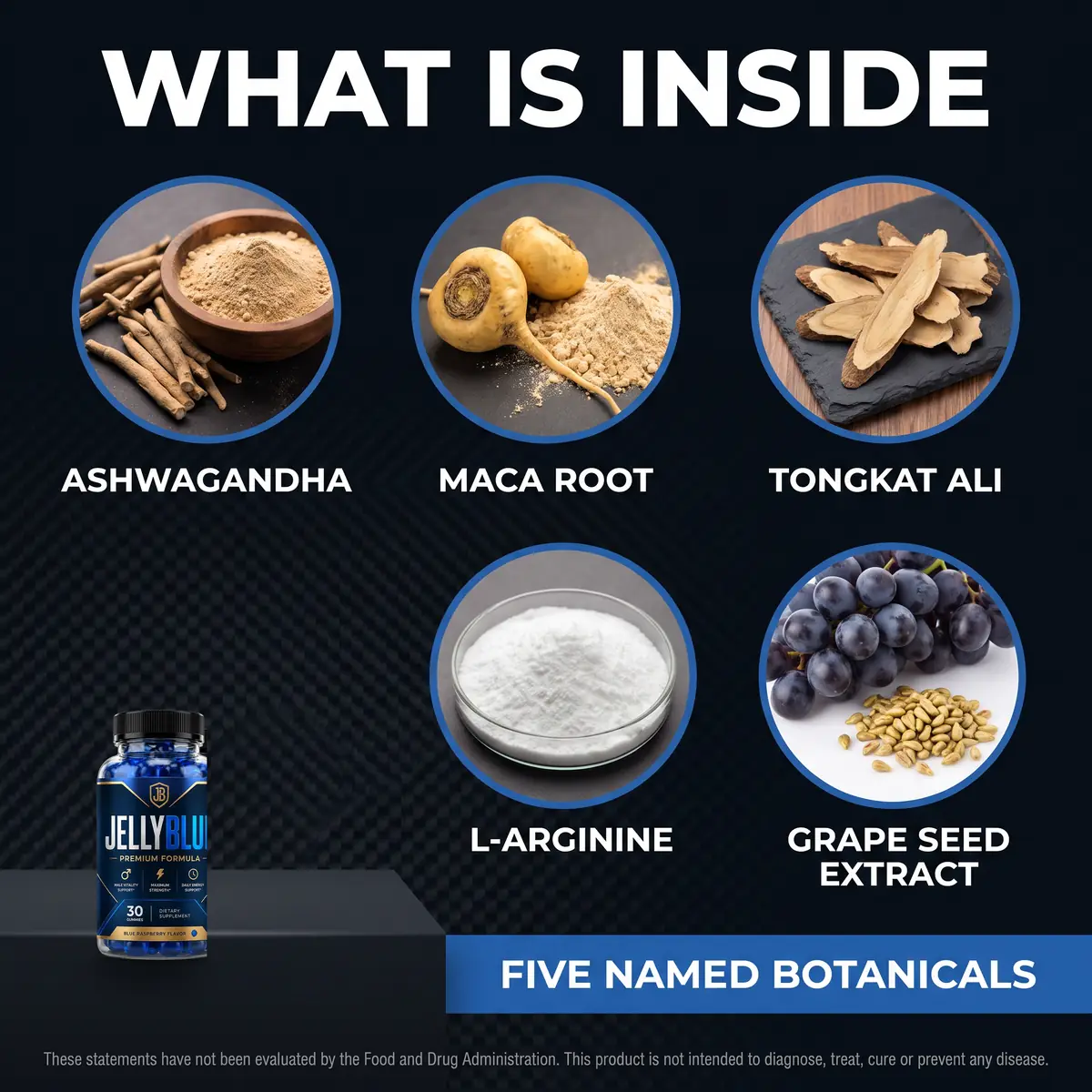
The printed Supplement Facts panel gives the active line as "Tongkat Ali (Eurycoma longifolia) 200 mg" with a Latin binomial and a milligram figure, and marks the Daily Value as not established, which is true of all seven actives on this panel and is normal for botanicals without a set government reference intake. What it does not carry is any of the specification language the trials above used: no extract ratio such as 50:1 or 100:1, no percentage of a marker compound such as eurycomanone or total glycosaponins, and no brand or trademark name for a standardized extract. The "other ingredients" list, which covers the gummy base itself, is similarly silent on this point, as it should be; it is not where an active’s specification would appear.
That is not unusual for a gummy-format supplement. Extract specifications more commonly appear on capsule products, where a single active ingredient's sourcing is easier to headline, and gummies built around several botanicals at once tend to keep the panel to names and milligrams. It is still a real gap between what the trials specify and what this label states, and naming that gap plainly is more useful than pretending 200 mg alone answers the standardization question.
How a standardized extract actually gets checked
For a reader who wants to go further than this label allows, three things are worth knowing. First, an extract ratio printed on a bottle, such as 4:1, is a starting-material claim, not a potency guarantee, for the reasons above. Second, a named marker-compound percentage, such as "standardized to 22% eurycomanone" or a stated glycosaponin content, is a stronger claim because it describes what a laboratory actually measured in the finished product rather than what went into the extraction vessel. Third, a trademarked, branded extract such as Physta or LJ100 carries its own published specification and its own body of trials run specifically on that material, which is the closest a shopper gets to knowing in advance which study, if any, applies to the bottle in front of them.
None of those three checks is possible from the JellyBlue panel as printed. That does not mean the extract inside is inferior to the ones used in the trials above; it means the label does not give a reader the information needed to know either way, which is a fair thing to say plainly rather than either assume the best or assume the worst.
Why eurycomanone specifically
The reason quassinoid content, and eurycomanone in particular, is the marker labs reach for is mechanistic rather than arbitrary. A laboratory study using isolated rat testicular Leydig cells found that eurycomanone increased testosterone production in a dose-dependent way, largely by inhibiting aromatase, the enzyme that converts testosterone into estrogen. At higher concentrations in the same cell system, the compound also appeared to act on a second enzyme pathway. That is cell-culture evidence in rat tissue, not a human trial, and it does not by itself explain what a standardized extract does in a person who swallows a gummy. What it does explain is why an analytical chemist quantifying a Tongkat Ali extract measures eurycomanone and its relatives rather than, say, total plant weight: it is the compound with a described mechanism, which is what a marker-compound standardization is supposed to track.
Put the two pieces together and the standardization question stops being abstract. A 200 mg line that happens to carry a meaningful eurycomanone content is, on the mechanism described above, plausibly doing something different from a 200 mg line of root material where that compound is present only in trace amounts. The panel gives no way to tell which one this gummy is, which is exactly the gap this article has been describing from a different angle in every section before this one.
Order JellyBlue knowing what the panel does and does not specify
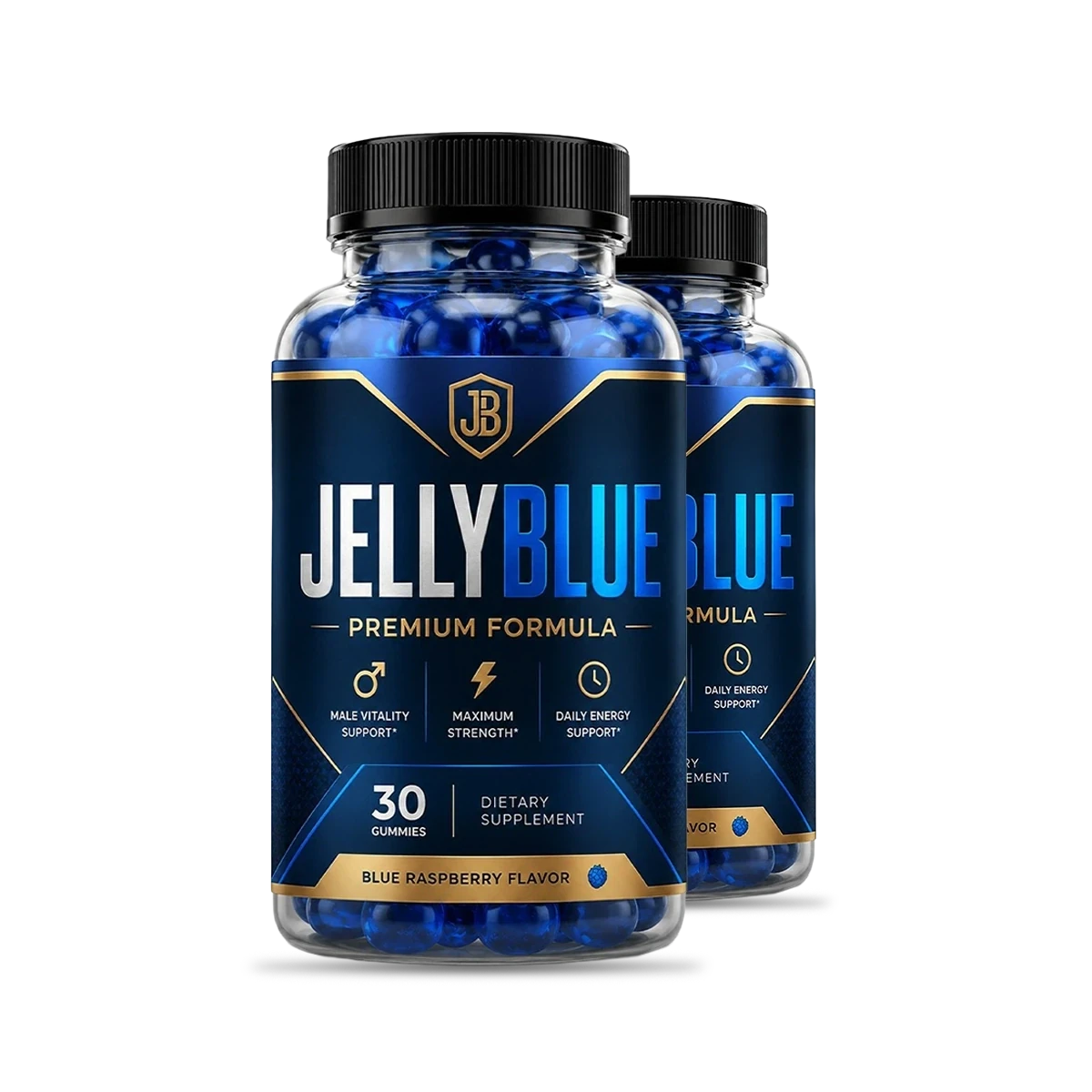
One chewable gummy a day, 30 to a bottle, 7 actives with a milligram figure beside every one. Two bottles covers the 60-day window exactly.
Price at the seller’s checkout · 60-day money-back guarantee from purchase
Order JellyBlueWhere the 200 mg figure still matters
None of the above makes the milligram figure meaningless. Whatever form of Tongkat Ali is actually inside this gummy, 200 mg of it a day is a fixed, printed, checkable commitment, and it is one a reader can hold the company to bottle after bottle in a way a proprietary blend never allows. It is also, as the dose-comparison article on this site sets out, closer to the range several trials used than most of the other six lines on this panel, which is a real point in the formula’s favor even without knowing the exact extract.
What the amount cannot do on its own is confirm that the material behind it is the kind that produced a result in a trial room. That is a separate question, this article's question, and it stays open on the evidence this label currently prints. A reader who wants it closed has one practical option: ask the seller, in writing, for the extract ratio or the standardization marker behind the 200 mg line, and treat a clear, specific answer as more informative than the number by itself ever could be.
It is worth saying, too, that this gap is common rather than unusual in this category. Reading a shelf of comparable gummies turns up the same "Tongkat Ali" line, at a similar milligram figure, on product after product, with almost none of them naming an extract ratio or a marker-compound percentage either. That does not make the gap acceptable, but it does mean a reader who wants this question answered will likely have to write the same email to several companies before finding one willing to give a specific answer rather than a repeated milligram figure.
The dose-comparison article sets this same 200 mg against every trial amount across all seven ingredients, and the ingredients page carries the full botanical list this label prints. This article narrows in on the one line the dose comparison could not answer by itself.
- Henkel RR, Wang R, Bassett SH, Chen T, Liu N, Zhu Y, Tambi MI. Tongkat Ali as a potential herbal supplement for physically active male and female seniors—a pilot study. Phytother Res. 2014;28(4):544-50. PMID 23754792. https://pubmed.ncbi.nlm.nih.gov/23754792/
- Chinnappan SM, George A, Pandey P, Narke G, Choudhary YK. Effect of Eurycoma longifolia standardised aqueous root extract-Physta® on testosterone levels and quality of life in ageing male subjects: a randomized, double-blind, placebo-controlled study. Food Nutr Res. 2021;65:5647. PMID 34262417. https://pubmed.ncbi.nlm.nih.gov/34262417/
- Leitão AE, Vieira MCS, Pelegrini A, da Silva EL, Guimarães ACA. A 6-month, double-blind, placebo-controlled, randomized trial to evaluate the effect of Eurycoma longifolia (Tongkat Ali) and concurrent training on erectile function and testosterone levels in androgen deficiency of aging males (ADAM). Maturitas. 2021;145:78-85. PMID 33541567. https://pubmed.ncbi.nlm.nih.gov/33541567/
- Xiu-Ming C, Dong-Sheng F, Jing-Ming Z, Xiao-Xian Z, Bin L, Hai-Long W, Qing Z. Qualitative and quantitative analysis of quassinoid diterpenoids from Eurycoma longifolia by UPLC-Q-TOF-MS. Zhongguo Zhong Yao Za Zhi. 2020;45(19):4667-4676. PMID 33164431. https://pubmed.ncbi.nlm.nih.gov/33164431/
- Low BS, Choi SB, Abdul Wahab H, Das PK, Chan KL. Eurycomanone, the major quassinoid in Eurycoma longifolia root extract increases spermatogenesis by inhibiting the activity of phosphodiesterase and aromatase in steroidogenesis. J Ethnopharmacol. 2013;149(1):201-207. PMID 23810842. https://pubmed.ncbi.nlm.nih.gov/23810842/
- NIH Office of Dietary Supplements. Dietary Supplements: What You Need to Know. Accessed September 2026. https://ods.od.nih.gov/factsheets/WYNTK-Consumer/
- National Center for Complementary and Integrative Health. Using Dietary Supplements Wisely. NIH, accessed September 2026. https://www.nccih.nih.gov/health/using-dietary-supplements-wisely