JellyBlue Official Website › Articles › Label literacy
Label literacyHow to Read the JellyBlue Supplement Facts Panel
A Supplement Facts panel proves what the manufacturer says is in a serving, itemised, plus the serving size and the sugar. It does not prove the amounts were verified, that the contents match, that the amounts do anything, or that the formula was ever studied. Knowing which is which takes about ninety seconds a label.
What a Supplement Facts panel actually is
It is the box on the back of the bottle, and it is the only part of a supplement’s packaging with a required format. A serving size, a number of servings, the nutrition lines where they apply, then the actives with an amount beside each, then a percent Daily Value where one exists, then the other ingredients.
Everything else on the pack, the front, the seals, the three phrases under the icons, the graphics in the listing, is marketing. It is allowed to be selective. The panel is not, and that asymmetry is the most useful thing a buyer in this category can understand.
The NIH consumer sheet on dietary supplements and the FDA’s questions and answers page both set out what the label is obliged to carry, and the short version is: less than most people assume, but the panel is the part that is obliged.
JellyBlue is a dietary supplement and not a treatment. Nothing here is medical advice. Erectile difficulty that is new or persistent is frequently the first sign of a cardiovascular problem, which makes it worth an appointment rather than a purchase, and MedlinePlus is a reasonable place to start reading.
The four things a panel does prove
- What the manufacturer says is in it, itemised. A panel with a milligram figure beside every active is a specific, falsifiable set of statements. It can be tested and it can be wrong, which is exactly what makes it worth something.
- The serving size, which decides everything else. Every figure in the box is per serving. A bottle of sixty at three capsules a serving is a twenty-day bottle, whatever the front says.
- Whether the manufacturer is hiding amounts. The words proprietary blend followed by one number covering several names mean the individual amounts are not disclosed. That is a choice, not a requirement.
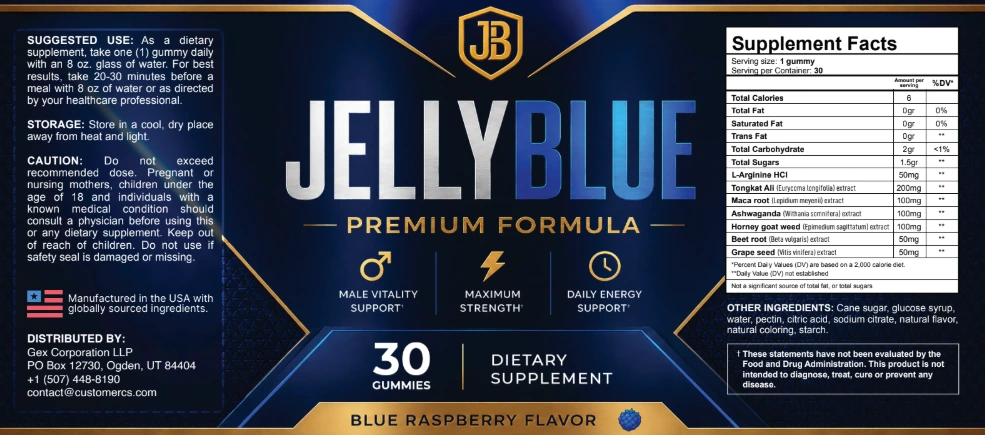
- The sugar, the calories and the carbohydrate. On a gummy this matters. A JellyBlue gummy is 6 calories with 2 g of carbohydrate and 1.5 g of total sugars, printed rather than left to be inferred.
The four things a panel does not prove
| What a reader assumes | What is actually true |
|---|---|
| The amounts have been verified | By the manufacturer, to its own satisfaction. No regulator tested this bottle before it went on sale, and no independent assay is implied by a printed number. |
| The ingredients are what they say | This is the unsettling one. Products in this category have repeatedly been found to contain undeclared synthetic PDE5 inhibitors, and the FDA publishes the list. A panel is a claim, not an assay. |
| The amounts are enough to do anything | A panel is silent on this. It states what is in a serving; it makes no comparison with what any trial used, and nothing requires it to. |
| The formula has been studied | Almost never. The ingredients may have been studied separately. The combination, at these amounts, in this format, essentially never has. |
None of the four is a criticism of any particular product. They are the ordinary limits of what a printed label can carry.
The second row is worth dwelling on, because it is the one that separates this aisle from the vitamin aisle. When an analysis of purported herbal sexual enhancers found prescription-strength drugs inside a meaningful share of them, every one of those products had a label. The label was simply not a true account of the contents.
That does not make panels worthless. It makes provenance and disclosure the two things worth checking together: who the chain of custody runs through, and whether the manufacturer chose to itemise or to hide behind a blend total. A proprietary blend removes the question of amounts entirely, which is a smaller problem than adulteration and a much more common one.
Order JellyBlue from a desk that reproduces the panel
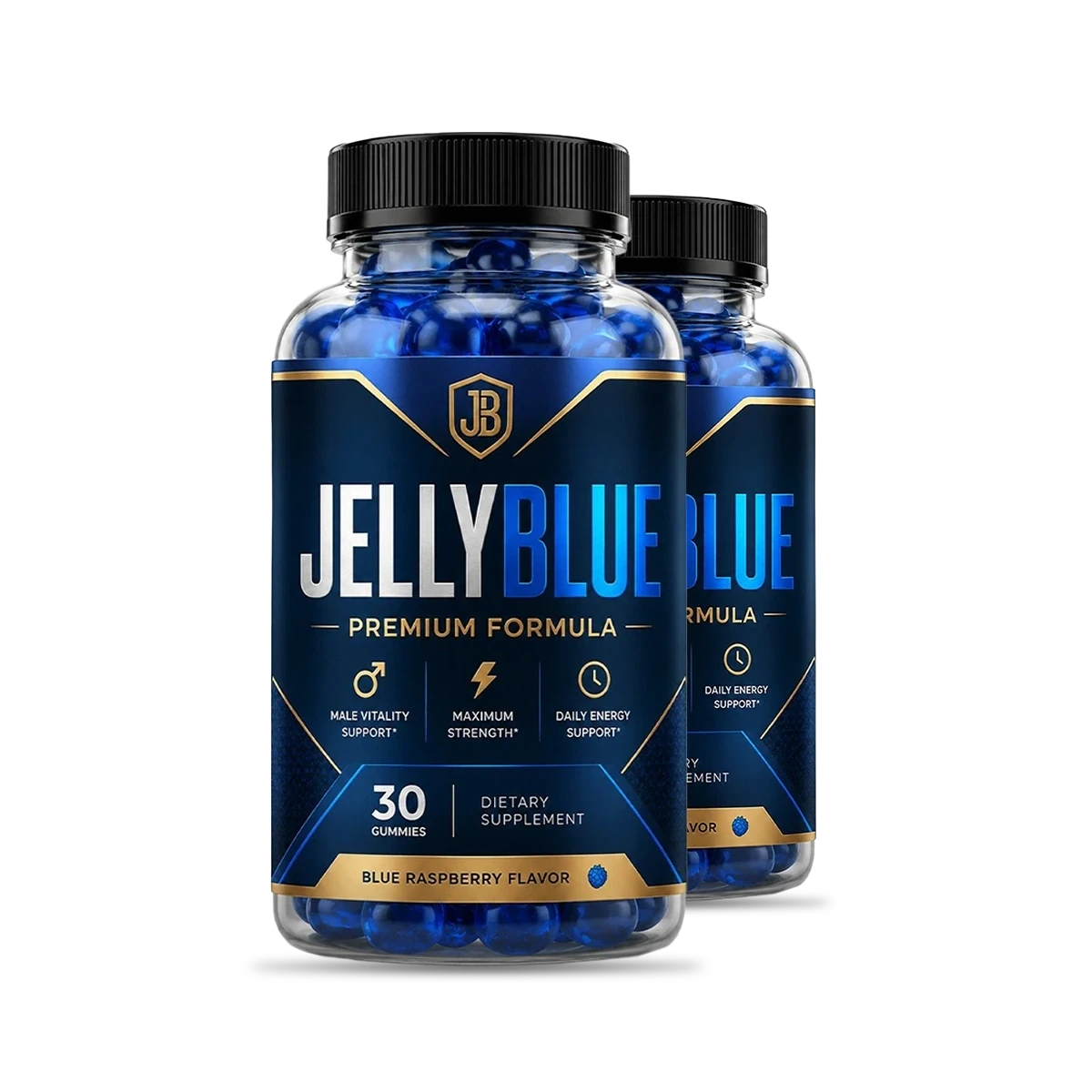
One chewable gummy a day, 30 to a bottle, 7 actives with a milligram figure beside every one. Two bottles covers the 60-day window exactly.
Price at the seller’s checkout · 60-day money-back guarantee from purchase
Order JellyBlue From This DeskLot JEL-26/JE-3218 · one gummy a day, 30 to a bottle · ships from the United States
How to read one in ninety seconds
- Find the serving size. Then multiply out: servings per container times days per serving is how long the bottle lasts.
- Add the actives together. One number. It tells you more about a formula than the ingredient count does, and a label naming fifteen botanicals that total 40 mg has just told you something the front of the bottle did not.
- Look for a blend total. If there is one, stop comparing amounts. You have a ceiling and nothing else.
- Compare the biggest line against a trial. Not against another label. The category guide gives trial amounts for the eight names that keep appearing in this aisle.
- Read the other-ingredients line. It tells you what the product is made of rather than what it claims: pectin or gelatine, cane sugar or a sweetener, and whether a colouring is natural or not.
What a panel on a gummy tells you that a capsule panel does not
A gummy has a fixed volume and most of that volume is not active. Pectin, cane sugar, glucose syrup, water, citric acid, sodium citrate, flavour, colour and starch make the sweet part; the actives are carried in what is left.
That is the mechanical reason gummy formulas carry less than capsule formulas of the same names, and it is why 650 mg of actives is a reasonable figure for a gummy and a modest one for a capsule. A reader comparing a gummy with a capsule on milligrams alone is comparing two different physical problems.
It is also why the sugar line matters here and does not matter on a capsule. 1.5 g a day is negligible in an ordinary diet and is not negligible to somebody counting carbohydrate deliberately. Either way, the figure is on the panel so it can be counted.
Three labels, read side by side
The method above is easier to trust with a worked example, so here are three labels a buyer in this category will meet. None of them is invented: they are the three shapes the shelf actually offers.
| What the panel says | What you can work out | What you cannot |
|---|---|---|
| Seven actives, a milligram figure beside each, no blend | The amount of every ingredient, the total, and how each amount compares with a published trial. Everything is checkable. | Whether the bottle contains what the label says. A panel is a claim, and only an assay settles that. |
| Proprietary blend, 750 mg, eight names listed underneath | One ceiling. Nothing inside the blend can exceed 750 mg, and the first name is conventionally the largest. | Any individual amount. The eighth name could be a milligram and the label would be entirely accurate. |
| Six actives itemised, serving size three capsules, bottle of 60 | The amounts, and that the bottle lasts twenty days rather than sixty. Multiply before comparing prices. | Whether a competitor's one-capsule serving is weaker: it may carry the same amount in a third of the volume. |
Three shapes, three different reading problems. Only the first lets a buyer compare an amount with a trial, which is the comparison that decides whether a formula is plausible.
The middle row is the one worth dwelling on, because a proprietary blend is not a scandal and is frequently misread as one. A blend total is a legal disclosure and the manufacturer has reasons for it, some of them commercial and some of them about a formulation it does not want copied. What it does, unavoidably, is make every comparison in this article impossible. You cannot check an amount you have not been given.
The third row is the commonest trap on a price comparison. Two bottles at the same price with the same count are not the same purchase if one needs three capsules a serving. The NIH consumer sheet puts serving size first for that reason, and it is the first thing this article asks you to find.
On this product the panel is the first shape. 7 actives, 7 numbers, a serving of one gummy and 30 servings a container, which is why every other page on this website can print a comparison instead of an adjective.
Does the label print an amount for every active, or is there a blend total? Everything else on a supplement page is downstream of that answer, because without itemised amounts there is nothing to compare, nothing to check and nothing to be wrong about. The nine-point checklist puts it first for that reason, and scores JellyBlue against it including the two checks it fails.
- NIH Office of Dietary Supplements. Dietary Supplements: What You Need to Know. Accessed September 2026. https://ods.od.nih.gov/factsheets/WYNTK-Consumer/
- US Food and Drug Administration. Questions and Answers on Dietary Supplements. Accessed September 2026. https://www.fda.gov/food/information-consumers-using-dietary-supplements/questions-and-answers-dietary-supplements
- Campbell N, Clark JP, Stecher VJ, Thomas JW, Callanan AC, Donnelly BF, Goldstein I, Kaminetsky JC: Adulteration of purported herbal and natural sexual performance enhancement dietary supplements with synthetic phosphodiesterase type 5 inhibitors, J Sex Med 2013;10(7):1842-9. PMID 23634714. https://pubmed.ncbi.nlm.nih.gov/23634714/
- US Food and Drug Administration. Tainted Sexual Enhancement Products. Medication Health Fraud, accessed September 2026. https://www.fda.gov/drugs/medication-health-fraud/tainted-sexual-enhancement-products
- National Center for Complementary and Integrative Health. Using Dietary Supplements Wisely. NIH, accessed September 2026. https://www.nccih.nih.gov/health/using-dietary-supplements-wisely
- MedlinePlus. Dietary Supplements. US National Library of Medicine, accessed September 2026. https://medlineplus.gov/dietarysupplements.html