JellyBlue Official Website › Articles › Plain-words guide
Plain-words guideHow JellyBlue Works: The Seven Label Actives
Many men past fifty read the label of a supplement twice: once for what it says and once for what it leaves out. If you are asking how does JellyBlue work, you deserve an answer that separates what a mechanism is from what a result is. This page does that, using the site’s own pages and the printed panel.
Quick answer. How does JellyBlue work? Its seven printed actives act along three routes: three touch blood-vessel width, two are adaptogens studied for stress and sleep, and two are traditional names. That describes mechanisms, not results. No trial of this gummy exists, so the label makes only gentle support statements.
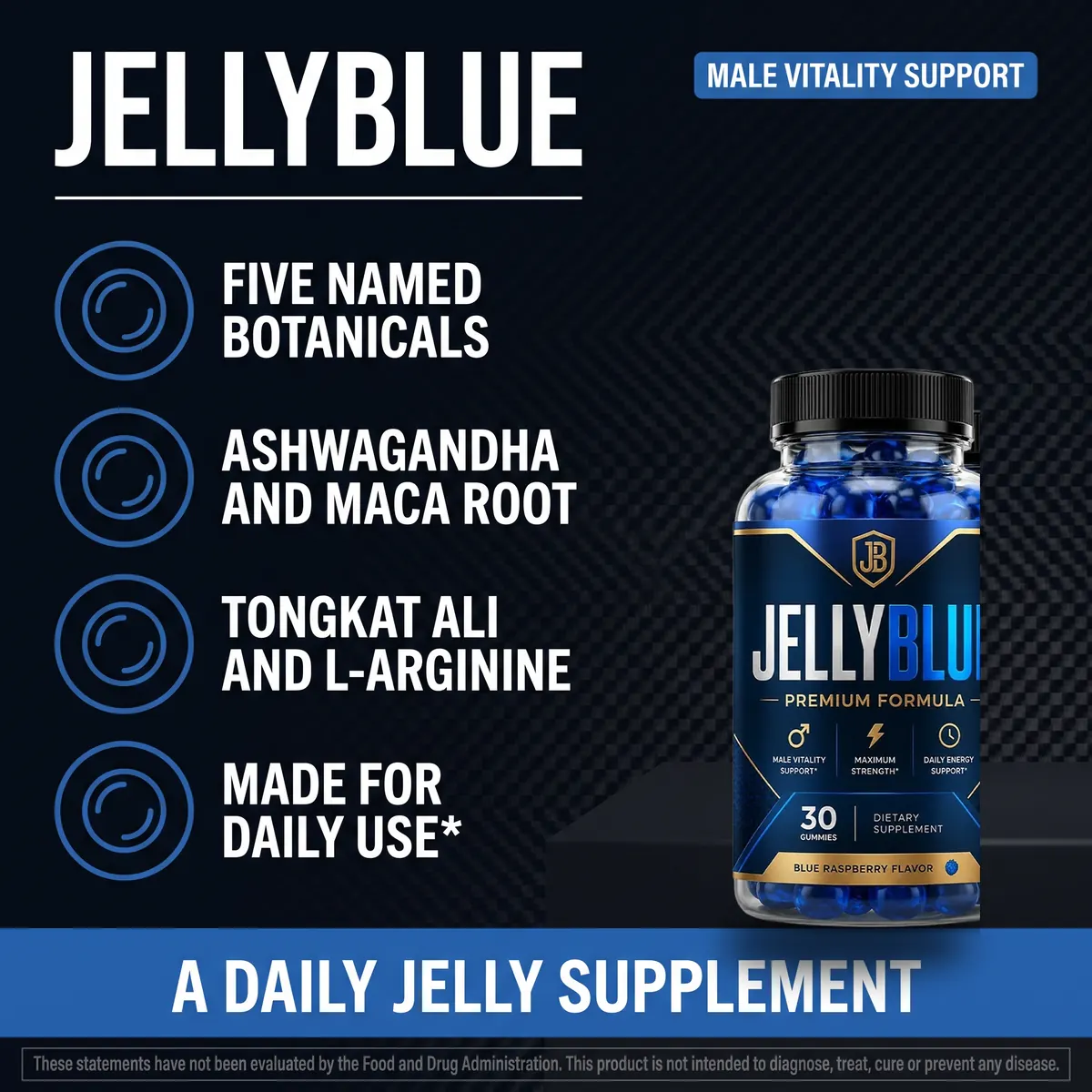
How does JellyBlue work in one short picture?
Think of the formula as three small groups. Each group links to a different kind of published research. None of the groups is a quick fix, and none is a drug.
The first group is about how wide a blood vessel sits. The second is about stress, sleep and desire. The third is a pair of traditional names that have been used in this product category for a long time. The label sums it up with the words Male Vitality Support.
Mechanism is the key word. A mechanism says how an ingredient might act. A result says what happened to people who took it. This page covers the first. For the second, the honest answer is that nobody has tested this gummy.
How does JellyBlue work on blood-vessel width?
Three lines on the panel reach the same body signal, called nitric oxide, by three different paths. Nitric oxide tells the muscle in a vessel wall to relax, and a relaxed vessel is wider.
L-arginine HCl at 50 mg is the raw material the body uses to make nitric oxide. Beet root extract at 50 mg carries dietary nitrate, which the body can turn into nitric oxide by another path. Grape seed extract at 50 mg acts on the lining of the vessel.
The amounts matter. The arginine research the site cites found its blood-pressure effect mostly above four grams a day, against 50 mg in a gummy. The nitrate research worked at roughly 300 to 500 mg of nitrate a day, and the panel does not say how much nitrate the beet root extract holds. So the routes are real, and the amounts are small.
Because these three lines act on the same pathway as some prescription medicines, there is one interaction worth a conversation. If you take a nitrate, a blood-pressure medicine or a PDE5 inhibitor, ask whoever prescribes it before the first gummy.
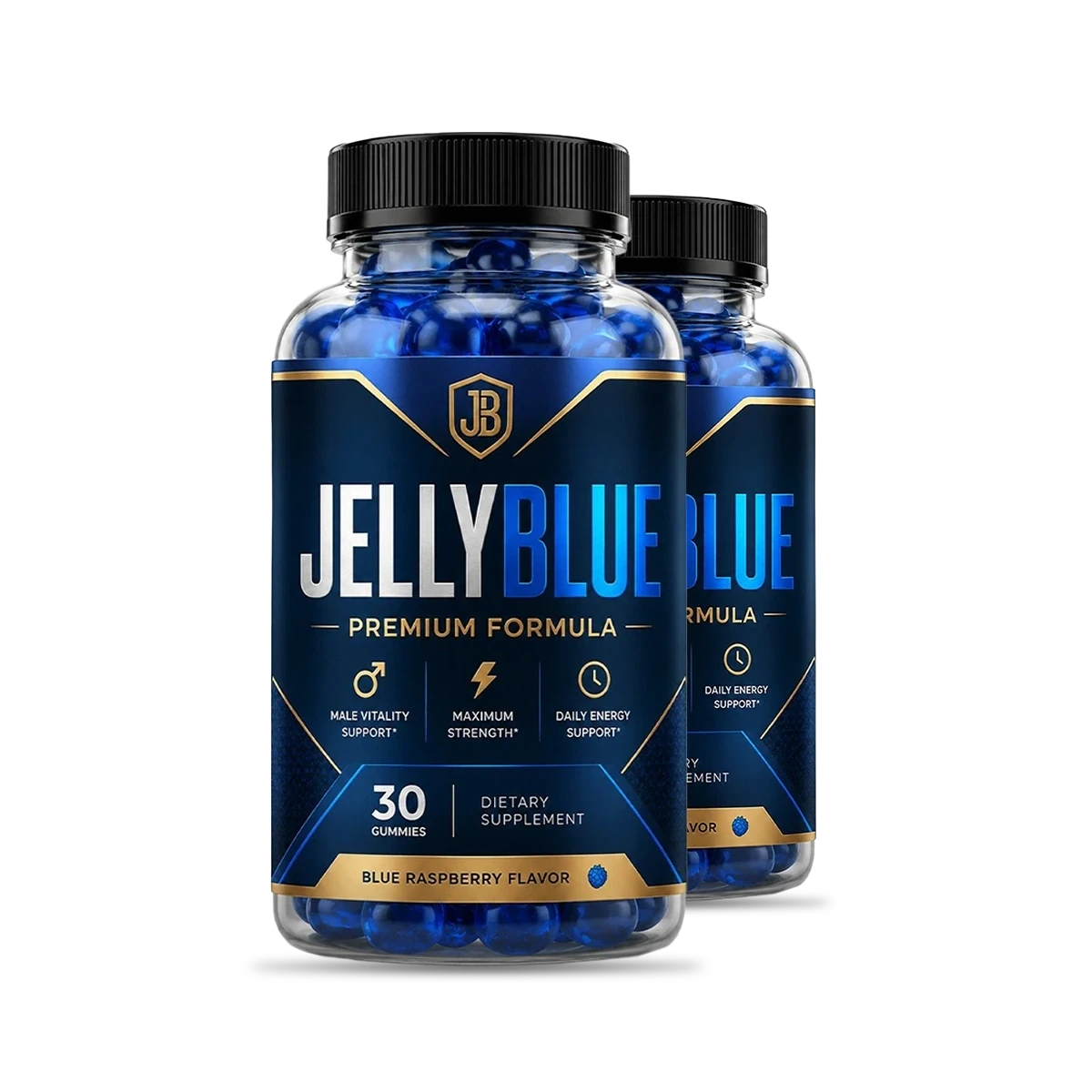
Read the panel, then decide
Every one of the seven amounts is printed. The checkout shows the pack price before you pay, and the 60-day window counts from purchase.
Price at the seller’s checkout · 60-day money-back guarantee from purchase
See the price and 60-day guaranteeLot JEL-26/JE-3218 · one gummy a day, 30 to a bottle · Jellyeblue earns when you buy through the order link
Does JellyBlue work through stress, sleep and desire?
Ashwagandha at 100 mg and maca root at 100 mg are the second group. The published research on ashwagandha looks at stress, anxiety and sleep. The maca research the site cites looked at self-reported desire, and found it changed without a change in testosterone.
Both are slow stories. The trials behind them ran for weeks, not hours, and they used larger amounts than a gummy holds. That is why the people who write reviews on the site describe a wait of 3 to 4 weeks, and a quiet first week.
This is also why nothing on the panel feels like a jolt. There is no caffeine and no other stimulant, so there is nothing to feel on day one.
What do the two traditional names do?
Tongkat ali is the largest line at 200 mg, and it is the one line that matches the amount used in the trials the site cites. Those were small trials of a standardised extract.
Horny goat weed at 100 mg is included for a compound called icariin. The research the site cites is laboratory work, not a study of men taking a dose. So the site treats it as a traditional name with a laboratory finding behind it, and nothing stronger.
Put together, the sensible reading is modest. The formula is a small daily support built on real mechanisms at small amounts. It is not a treatment for any condition, and the site says so.
Key facts: how JellyBlue is built
- Seven printed actives add up to 650 mg in one gummy.
- Blood-vessel route: L-arginine HCl 50 mg, beet root 50 mg, grape seed 50 mg.
- Stress, sleep and desire route: ashwagandha 100 mg, maca root 100 mg.
- Traditional names: tongkat ali 200 mg, horny goat weed 100 mg.
- Only tongkat ali matches the amount used in the trials the site cites.
- No stimulant and no caffeine on the panel.
- No trial of this gummy exists, and no safety study of the seven together.
- Not a treatment for any condition, and not FDA approved.
Which ingredient sits on which route?
| Route | Ingredient | Per gummy | What the research looked at |
|---|---|---|---|
| Vessel width | L-arginine HCl | 50 mg | Blood pressure, mostly above four grams a day |
| Vessel width | Beet root | 50 mg | Dietary nitrate and blood pressure |
| Vessel width | Grape seed | 50 mg | How well an artery widens |
| Stress and sleep | Ashwagandha | 100 mg | Stress, anxiety and sleep |
| Desire | Maca root | 100 mg | Self-reported desire |
| Traditional | Tongkat ali | 200 mg | Testosterone and erectile function in small trials |
| Traditional | Horny goat weed | 100 mg | Laboratory activity of icariin |
Amounts are from the printed panel. The research column summarises what the site’s ingredients and how-it-works pages say, not a claim about this gummy.
Frequently asked questions
Does JellyBlue work right away?
Nothing on the panel is a stimulant, so there is nothing to feel on day one. Reviewers on the site describe 3 to 4 weeks before they judge it, and results vary.
Is the beet root in JellyBlue a food or an extract?
The panel prints beet root extract, 50 mg. It does not say how much nitrate that extract holds.
Can JellyBlue be taken with blood-pressure medicine?
Ask whoever prescribes it first. Three lines act on blood-vessel width, and some medicines act on the same pathway, so the effects can add up.
Why are the amounts smaller than the studies?
A gummy has a fixed size and most of it is pectin and sweetener. Six of the seven lines sit below the amounts the cited trials used.
Does JellyBlue raise testosterone?
The label does not claim that. A review of tongkat ali reported higher total testosterone in small trials of an extract, which is a finding about those trials, not this gummy.
Is it right for every man over fifty?
No. It is written for healthy adult men. Anyone with liver disease, or on a nitrate, blood-pressure medicine or PDE5 inhibitor, should speak to a doctor before using it.
How long does JellyBlue take to work?
The page says results are not a week-one event, because the formula has no stimulant in it. Many readers wait about 3 to 4 weeks before judging it, within the 60-day money-back window.
What are the active ingredients in JellyBlue?
JellyBlue lists seven actives on its Supplement Facts panel, totalling 650 mg in one gummy. Beet root extract at 50 mg is one of them. The full list with each printed amount is on the ingredients page.
What are the seven actives on the JellyBlue label?
The label lists seven actives that add up to 650 mg in one gummy a day. They include beet root extract at 50 mg and tongkat ali at 200 mg.
Our view
So, how does JellyBlue work? Asking how a supplement works is the right instinct, and this one answers it better than most because it prints its amounts. The mechanisms are real. The amounts are small. The evidence for the finished gummy is absent, and the site does not pretend otherwise.
If you are over fifty and take any regular medicine, the interaction note matters more than the mechanism. Speak to your doctor or pharmacist first, then, if they are comfortable, treat the 60-day window as your test.
Related reading: the JellyBlue home page, the male vitality supplement guide and the article on seven amounts against seven trials.
Want to see the packs?
One gummy a day, 30 to a bottle, no stimulant on the panel. Two bottles cover the whole 60-day window at the label dose.
Price at the seller’s checkout · 60-day money-back guarantee from purchase
See the price and 60-day guaranteeLot JEL-26/JE-3218 · one gummy a day, 30 to a bottle · ships from the United States · Jellyeblue earns when you buy through the order link
- Shiraseb F, Asbaghi O, Bagheri R, Wong A, Figueroa A, Mirzaei K: Effect of l-Arginine Supplementation on Blood Pressure in Adults: A Systematic Review and Dose-Response Meta-analysis of Randomized Clinical Trials, Adv Nutr 2022;13(4):1226-1242. PMID 34967840. https://pubmed.ncbi.nlm.nih.gov/34967840/
- Ashor AW, Lara J, Siervo M: Medium-term effects of dietary nitrate supplementation on systolic and diastolic blood pressure in adults: a systematic review and meta-analysis, J Hypertens 2017;35(7):1353-1359. PMID 28319596. https://pubmed.ncbi.nlm.nih.gov/28319596/
- Foshati S, Nouripour F, Sadeghi E, Amani R: The effect of grape (Vitis vinifera) seed extract supplementation on flow-mediated dilation, blood pressure, and heart rate: A systematic review and meta-analysis of controlled trials with duration- and dose-response analysis, Pharmacol Res 2022;175:105905. PMID 34798267. https://pubmed.ncbi.nlm.nih.gov/34798267/
- Arumugam V, Vijayakumar V, Balakrishnan A, Bhandari RB, Boopalan D, Ponnurangam R, Sankaralingam Thirupathy V, Kuppusamy M: Effects of Ashwagandha (Withania Somnifera) on stress and anxiety: A systematic review and meta-analysis, Explore (NY) 2024;20(6):103062. PMID 39348746. https://pubmed.ncbi.nlm.nih.gov/39348746/
- Cheah KL, Norhayati MN, Husniati Yaacob L, Abdul Rahman R: Effect of Ashwagandha (Withania somnifera) extract on sleep: A systematic review and meta-analysis, PLoS One 2021;16(9):e0257843. PMID 34559859. https://pubmed.ncbi.nlm.nih.gov/34559859/